
BMW i8 (2014 – 2020) Review
.jpg?width=640&height=426&rmode=crop)
.jpg?width=640&height=426&rmode=crop)
.jpg?width=640&height=426&rmode=crop)
.jpg?width=640&height=426&rmode=crop)
.jpg?width=640&height=426&rmode=crop)
.jpg?width=640&height=426&rmode=crop)
.jpg?width=640&height=426&rmode=crop)
.jpg?width=640&height=426&rmode=crop)
.jpg?width=640&height=426&rmode=crop)
.jpg?width=640&height=426&rmode=crop)
.jpg?width=640&height=426&rmode=crop)
.jpg?width=640&height=426&rmode=crop)
.jpg?width=640&height=426&rmode=crop)

BMW i8 (2014 – 2020) Verdict

 Redefines hybrid performance. Great sound from little 1.5-litre three-cylinder engine. Mighty through corners with effortlessly smooth acceleration. An absolute joy to drive.
 Tiny boot unless rear seats are used for luggage. Discontinued from April 2020.
Find out more about the BMW i8 (2014 – 2020)
Insurance Group 50
On average it achieves 36% of the official MPG figure
The BMW i8 marks a revolution. Not just for hybrid cars but for sports cars in general. The technology may be incredibly advanced but the principle is really very simple. A small 1.5-litre engine, borrowed from the MINI, powers the rear wheels while an electric motor drives the front wheels. In between are the lithium ion batteries which means a low centre of gravity and perfect weight distribution.
The result? A phenomenally good sports car that sets new rules for how performance should be delivered and how a driver's car can feel. Forget the fact this is a plug-in hybrid, instead just appreciate the BMW i8 for what it is. One of the best cars on the road today, regardless of how it's powered.
Of course the styling certainly adds to the appeal. The i8 looks like a concept that's just been driven off a motorshow stand. It wouldn't feel out of place in a futuristic Hollywood blockbuster. If you want a car that gets noticed, even on the streets of central London that are awash with McLarens and Aston Martins, the i8 is it.
The low nose and menacing headlights flow into a fairly conventional coupe design but it's at the back where this BMW stands out. The roof panels flow down to create a floating spoiler over the rear lights. It's a car you could stand and admire for a very long time.
There are other flourishes too, such as the dihedral 'butterfly' opening doors which add to the feeling that this is a very special car. As you'd expect, carbon fibre plays a big part in the construction, from the doors to the roof and even the bodyshell, which means a kerb weight of just 1490kg - that's not much more than a Ford Focus TDCi.
This light weight means storming performance. Acceleration from 0-62mph takes just 4.4 seconds - that's Porsche 911 Carrera S territory - helped by a total of 362PS and, more crucially, a huge 570Nm of torque.
Of course the i8 isn't merely about performance. As it's a plug-in hybrid it's also incredibly efficient. According to the official figures CO2 is just 49g/km, which means you can drive into central London for free, while average economy is a claimed 135mpg - although these figures are always skewed by plug-in hybrids. More useful is the range. With a full tank and a fully charged battery the i8 can cover around 310 miles.
And don't think that because this is a hybrid it's going to be anodyne or quiet. The i8 is enthralling to drive and a real joy, plus you can forget any ideas that it doesn't sound the part either. BMW has somehow managed to make that little 1.5-litre engine sound like a flat six with a gorgeous noise from both inside the cabin and out. It may be expensive, but for the lucky few who get their hands on one, the i8 is a tour de force.
.jpg?width=240&height=160&rmode=crop)

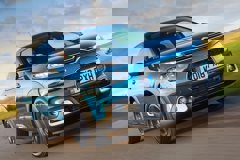

BMW i8 (2014 – 2020) handling and engines
- Engines range from i8 Roadster to i8
- Readers report Real MPG to be between 37–54 mpg
BMW's ability to extract seemingly impossible levels of power from engines reaches it peak in the i8. While the combined power of the combustion engine and electric motor is 362PS, what's mightily impressive is that the tiny 1.5-litre three-cylinder engine contributes 231PS of that.
Don't forget that this is an engine borrowed from the MINI Cooper where it develops a far more modest 136PS. Of course changes like the fact it's fitted with BMW Twinpower Turbo technology helps a great deal. Despite the name that actually only involves one turbo, the Twinpower bit refers to the combination with high precision injection.
While the small combustion engine powers the rear wheels, the front wheels are driven by a 131PS electric motor which also provides 250Nm of torque from a standstill. As with other hybrid cars, the electric motor provides assistance to the petrol engine when needed and can also power the i8 itself, with a range of 22 miles and a maximum speed of 75mph.
That may sound a little complex but from behind the wheel of the i8 there's no need to worry about any of that. The car takes care of the power distribution, you just get to enjoy the superb handling and stunning performance. While the benefits of electric power are known to drivers of EVs and hybrids, the i8 takes things to a whole new level. Like any other hybrid it's quiet when you pull away and incredibly refined at low speeds with no wind or road noise from within the cabin.
The carbon fibre structure really comes into its own here as the rigid structure means there are no rattles on the move and while the ride is sportily firm, it's still forgiving enough to be comfortable. In the standard Comfort mode, the battery drives the i8 at low speeds with the engine only kicking in above 75mph or when you need more power, such as overtaking. If you're gentle on the throttle, the electric motor will do all the work.
You can of course put the i8 into electric only mode which means the electric motor will drive the car up to 75mph (where the petrol engine kicks in) providing it has enough charge in the battery of course. However, put the i8 into Sport mode - which involves simply knocking the gear lever across the left - and the i8 really shines.
Sport mode stiffens the suspension, changes the electric power steering to be more reactive and sharpens the throttle response. The result is an utterly compelling sports car that not only goes well but sounds superb too, with that tiny three-cylinder engine somehow creating a unique yet gorgeous sound.
In fact it's very difficult not to drive the i8 in its Sport mode all the time, such is the wonderful feel and noise. With all that torque available from a zero revs, it's effortlessly quick from low speeds, for example when coming out of a slow corner, while the engine provides the power higher up. What's great is that as the driver, you don't notice any of this going on, you just get to enjoy a sports car that feels unlike anything else out there.
The perfect 50/50 weight distribution means it's amazingly composed through corners with impressive composure at both high and low speeds giving you endless confidence in its ability to tackle a series of bends. As it's four-wheel drive, traction is immense, even in the wet while the electric power steering has decent feel and a good weight to it. On paper it will accelerate from 0-62mph in just 4.4 seconds but it's the immediacy of the in-gear acceleration which most impresses. This is no frantic and stressed racer either, but a refined and smooth sports car.
| Engine | MPG | 0-62 | CO2 |
|---|---|---|---|
| i8 | 128 mpg | 4.4 s | 42–49 g/km |
| i8 Roadster | 128 mpg | 4.6 s | 46 g/km |
Real MPG average for the BMW i8 (2014 – 2020)
Real MPG was created following thousands of readers telling us that their cars could not match the official figures.
Real MPG gives real world data from drivers like you to show how much fuel a vehicle really uses.
Average performance
36%
Real MPG
37–54 mpg
MPGs submitted
20
BMW i8 (2014 – 2020) interior
- Boot space is 154 litres
| Dimensions | |
|---|---|
| Length | 4689 mm |
| Width | 2218 mm |
| Height | 1289–1297 mm |
| Wheelbase | 2800 mm |
Despite its small size the i8 is actually a two-plus-two thanks to two small rear seats. In reality you are unlikely to ever use these with any gusto, instead they're useful as an extra place to put luggage.
That's pretty handy as the boot is best described as minimal with a 154-litre capacity, about enough for one small suitcase. But on the plus side you can get a Louis Vuitton tailor made carbon fibre luggage set which consists of two travel bags, a business case and a garment bag. And it only costs a mere £12,000. Ouch.
The rest of the interior isn't as ostentatious as the Louis Vuitton luggage set. In fact it's suprisingly straightforward. Often the temptation for manufacturers of top end sports cars like the i8 is to throw everything at them, making for an overly complex car to drive and baffling, button-laden cabin. Instead the i8 stays true to the BMW ethos of simple design.
Get behind the wheel and you're greeted by a stylish interpretation of BMW's steering wheel alongside a standard BMW gear selector and a start button. For any BMW owner, it will be reassuringly familiar and that's a key thing here. The i8 may be very complex under the skin, but it's incredibly easy to drive. Press start, put it in D and away you go.
There are differences. The i8 is undeniably futuristic and that extends to elements like the instrument display. Gone are the conventional analogue dials, replaced by a totally digital full colour instrument display which changes depending on what mode you're in. In the Comfort and Eco Pro settings, there's a powermeter to show the electric motor useage but stick it on Sport and the whole thing turns red while the powermeter changes to a rev counter.
The quality is, of course, impeccable, with a plenty of attention to detail and a top level of fit and finish, illustrated by the premium feel of the leather seats, which are standard naturally. Everything works with real precision while the driving position is exactly what you want in a sports car - a low slung seat and plenty of adjustment in the steering column.
Given that this is a supercar with a near £100k price tag it's no surprise to find a generous level of standard equipment including the clever head-up display and the excellent Professional Navigation with an 8.8-inch display which is one of the best systems around with an easy to understand display and quick routing. It also shows you the area the i8 can cover on electric power alone.
The BMW i8 comes with AC Charging which means the battery can be charged from zero to 80 per cent within two hours via a BMW i Wallbox. At the moment these cost £315 to be installed, helped by a government grant, although for anyone buying an i8, a few hundred pounds on a wallbox is unlikely to be much of an issue.
Of course when you're not at home or work, owners will have to use public charging points. BMW has a system called BMW ChargeNow which gives access to a nationwide network of charging stations using a BMW i ChargeNow card. It costs £20 a year (with a pay as you go system) and charging points are displayed on the navigation screen along with whether they are currently in use or available.
BMW i8 (2014 – 2020) models and specs
| Dimensions | |
|---|---|
| Length | 4689 mm |
| Width | 2218 mm |
| Height | 1289–1297 mm |
| Wheelbase | 2800 mm |
| Miscellaneous | |
|---|---|
| Kerb Weight | 1485–1595 kg |
| Boot Space | 154 L |
| Warranty | 3 years |
| Servicing | 18000 miles |
| Spare Wheel | |||
|---|---|---|---|
| Standard | Tyre-repair kit | ||
| Costs | |
|---|---|
| List Price | £110,080–£116,305 |
| Insurance Groups | 50 |
| Road Tax Bands | A |
| Official MPG | 128.4–134.5 mpg |
| Euro NCAP Safety Ratings | |
|---|---|
| Adult | - |
| Child | - |
| Pedestrian | - |
| Overall | - |
Currently on sale
| Coupe | |||
|---|---|---|---|
| Version | List Price | MPG | 0-62 |
| 1.5 LCI Auto 2dr | - | 128.4 mpg | 4.4 s |
| Roadster | |||
|---|---|---|---|
| Version | List Price | MPG | 0-62 |
| 1.5 Auto 2dr | - | 128.4 mpg | 4.6 s |
On sale until October 2018
| Coupe | |||
|---|---|---|---|
| Version | List Price | MPG | 0-62 |
| 1.5 LCI Auto 2dr | £112,735 | - | 4.4 s |
| Coupe 1.5 Protonic Drk Silver Edition Auto 2dr | £110,080 | - | - |
| Coupe 1.5 Protonic Frozen Black Edition Auto 2dr | £114,655 | - | 4.4 s |
| Coupe 1.5 Protonic Frozen Yellow Edition Auto 2dr | £116,305 | - | 4.4 s |
| Coupe 1.5 Protonic Red Edition Auto 2dr | £112,535 | - | 4.4 s |
On sale until April 2017
| Coupe | |||
|---|---|---|---|
| Version | List Price | MPG | 0-62 |
| Coupe 1.5 Protonic Drk Silver Edition Auto 2dr | £110,080 | - | - |
Model History
- September 2011: BMW reveals i8 Concept
- April 2012: BMW i8 Spyder Concept unveiled
- May 2013: BMW reveals BMW i network
- March 2014: New i8 to make UK debut
- February 2015: Voted UK Car of the Year 2015
- February 2016: BMW i8 Protonic Red Edition announced
- November 2017: Mid life revamp of BMW i8 sees introduction of i8 Roadster
- January 0001: (OTR)
- March 2019: BMW i8 Coupé
- January 0001: BMW i8 Roadster
- December 2019
- January 2020
September 2011
BMW reveals i8 Concept
The BMW i8 Concept was presented as a member of the latest generation sports cars: progressive, intelligent and innovative. Its unique plug-in hybrid design combines an internal combustion engine and an electric drive, resulting in an exceptional driving experience – with extremely low fuel consumption and emissions.
April 2012
BMW i8 Spyder Concept unveiled
Although closely related to the original i8 Concept, the new i8 Concept Spyder is strictly a two-seater, with a shorter wheelbase and new, upward swivelling, windowless doors. It also features a fresh interpretation of the i8’s interior design, and additional on-board equipment including a pair of electric scooters, housed under a transparent tailgate.
Underneath the athletic and futuristic exterior skin, the i8 Concept Spyder is as advanced as its Coupé relation, built, once again, around the innovative LifeDrive architecture and underpinned by lightweight, modular construction.
A further example of the LifeDrive concept is the housing of the car’s lithium ion batteries in an ‘energy tunnel’ that joins the front and rear axles, thereby maintaining a low centre of gravity and ensuring BMW’s trademark 50:50 weight distribution.
The driver has three screens from which to access information: the twin ellipses of the instrument cluster, the central information display and the climate display. The cluster has a digital speedometer and an efficiency display, giving information on how much energy the driver is currently using or recuperating, as well as navigation details and fuel range. In the ECO PRO mode that maximises efficiency this ellipse turns blue: in SPORT mode it glows orange.
The 8.8-inch central screen displays a wide range of information from the status of the hybrid system to navigational data and connectivity functions. This is particularly important given the advanced suite of driver assistance systems found in the new i8 Concept Spyder, such as the camera-based proactive collision warning feature, park assistant and traffic jam assistant. By using a smart phone, the driver can find where his vehicle is parked with CarFinder; show nearby charging stations; allow batteries to be charged at pre-determined times and stay informed of the vehicle’s status. Even the interior can be pre-warmed on a cold morning.
A plug-in hybrid, the i8 Concept Spyder is powered by an eDrive drivetrain combining a high performance electric motor with a turbocharged, three-cylinder petrol engine. The lithium Ion batteries are stowed centrally for the benefit of weight distribution, and can be charged quickly from a domestic power socket. The i8 Concept Spyder uses a 131hp electric motor to power the front axle, and a 223hp turbocharged three-cylinder engine to power the rear axle. Both have been developed in-house by BMW. With its lightweight construction the combined power output of 354hp propels the Spyder from zero to 62mph in just 5.0 seconds and on to an electronically limited top speed of 155mph, yet delivers an outstanding combined fuel consumption of 94mpg.
The electric motor gets its energy from the car’s lithium ion batteries and can be fully charged via a domestic plug socket in under two hours. The Spyder has a range of 19 miles running on electric power alone, while a high voltage generator hooked up to the combustion engine can generate additional power if needed and store it in the battery. Due to the arrangement of the power sources, the Spyder can run in front-wheel, rear-wheel or all-wheel drive, the vehicle’s electronics deciding on the optimum configuration depending on the situation.
May 2013
BMW reveals BMW i network
From launch, 46 sales agents across the UK will offer the BMW i range. Each will have specialist technical capabilities allowing them to carry out repairs to the vehicles’ high voltage batteries. A wider service network is planned to offer extended coverage for the general service, maintenance and repair of BMW i vehicles.
As well as the vehicles themselves, BMW i will encompass a range of premium services for mobility aimed at optimising the use of parking spaces, recharging infrastructure, ‘smart’ navigation systems, intermodal route planning and access to other BMW vehicles on an ‘on-demand’ basis.
March 2014
New i8 to make UK debut
BMW’s most advanced sport car ever, the new BMW i8, was seen in action for the first time in the UK at the Goodwood Festival of Speed 2014. The BMW i8 went up the famous 1.16 mile course, showcasing the searing acceleration of the new plug-in hybrid sport car. The delivery of the first customer i8s will start in June 2014, while the introduction of optional BMW laser headlights for the BMW i8 is scheduled for autumn 2014. The BMW i8 will be the world’s first production car to offer this innovative lighting technology.
February 2015
Voted UK Car of the Year 2015
February 2016
BMW i8 Protonic Red Edition announced
Available for a limited period only, the new special edition BMW i8 Protonic Red Edition puts a new angle on the immediately recognisable BMW i model. The paintwork, created exclusively for this sports car comes in a Protonic Red finish with Frozen Grey metallic accents. The colour scheme is complemented by BMW W-spoke 470 light-alloy wheels painted in Orbit Grey metallic with hubs painted in Aluminium matt and mixed-size tyres (front: 215 R20, rear: 245/40).
|
Model |
|
Power Hp |
Torque Nm |
0 – 62mph Seconds |
Top Speed Mph |
CO2 Emissions g/km |
|
BMW i8 Protonic Red Edition |
£112,535 |
362* |
570* |
4.4 |
155** |
49 |
November 2017
Mid life revamp of BMW i8 sees introduction of i8 Roadster
The Roadster is joined in showrooms by the mid-life update of the i8 Coupé.
The i8 Roadster benefits from lightweight construction, complete with a low centre of gravity and even weight distribution. The aerodynamic exterior – with model-specific dihedral doors – is a fine exponent of the signature BMW i design language.
Passengers inside the i8 Roadster will look up to find either the open sky or a high-quality, all-season fabric soft-top with high-level soundproofing. All-electric operation ensures the roof opens or closes in an almost silent hush, within 16 seconds and while travelling at up to 31mph.
The i8 Roadster is unique in offering a fabric soft-top which stows into a perpendicular position in the rear when opened, therefore taking up very little space. The three segments of the roof fold vertically in a Z-shape, leaving an additional 100 litres of storage space between the roof box and the seats, on top of the 88 litres of cargo space in the rear compartment.
Opening the roof raises the rear window automatically by around 30mm, reducing air turbulence inside the cabin and ensuring passengers can enjoy the pleasure of open-top driving with minimal disturbance. The driver can adjust the height of the window at the touch of a button and control airflow as desired.
|
|
March 2019
BMW i8 Coupé
Fuel consumption combined: 1.8 l/100 km; Electric power consumption combined: 14,0 kWh/100 km; CO2 emissions combined: 42 g/km
January 0001
BMW i8 Roadster
Fuel consumption combined: 2.0 l/100 km; Electric power consumption combined: 14.5 kWh/100 km; CO2 emissions combined: 46 g/km
December 2019
Latest fuel and emissions figures for BMW i8 Coupe combined fuel consumption 1.8 l/100 km (157mpg); combined power consumption 14.0 kWh/100 km; combined CO 2 emissions 42 g/km. And for BMW i8 Roadster combined fuel consumption 2.0 l/100 km (141mpg); combined power consumption 14.5 kWh/100 km; combined CO 2 emissions 46 g/km (unchanged).
January 2020
BMW i8 discontinued from April 2020.
What to watch out for
BMW i8 discontinued from April 2020.
