
Ford Mondeo Estate (2015 – 2021) Review
.JPG?width=640&height=426&rmode=crop)
.JPG?width=640&height=426&rmode=crop)
.JPG?width=640&height=426&rmode=crop)
.JPG?width=640&height=426&rmode=crop)
.JPG?width=640&height=426&rmode=crop)
.JPG?width=640&height=426&rmode=crop)
.JPG?width=640&height=426&rmode=crop)

Ford Mondeo Estate (2015 – 2021) Verdict

 Excellent blend of enjoyable driving and comfort. Spacious load area. Practical and well finished cabin. Well priced.
 Volkswagen Passat Estate offers more technology and a better load area. 19-inch wheels impair ride quality.
Find out more about the Ford Mondeo Estate (2015 – 2021)
Insurance Groups are between 17–30
On average it achieves 77% of the official MPG figure
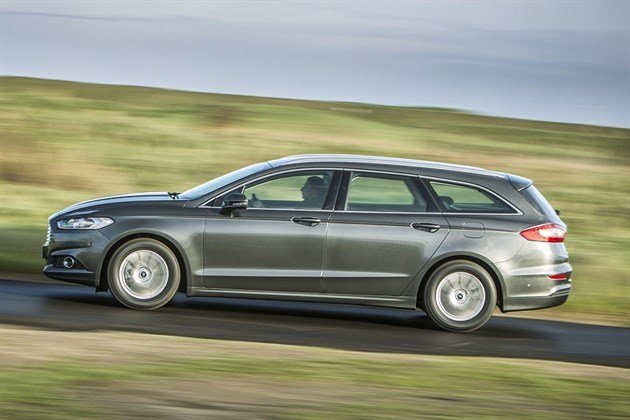
The Ford Mondeo Estate is one of the most capable - and spacious - estates around. There's more to it than a big boot though. It's extremely comfortable, good to drive and offers plenty of modern technology.
In terms of size, the estate variant offers 525 litres of space with the rear seats in place and 1630 litres with them folded. Ironically, the hatchback has more space with the rear seats up, but in reality, the estate is much more practical due to its shape, with a larger boot opening, making it better for carrying bulky items.
Like the hatchback, the estate offers a great blend of enjoyable handling and comfort. The Mondeo rides quietly and smoothly, even over rougher road surfaces, yet offers a good level of engagement and precision through twists and turns. That said, the ride quality is upset by the fitment of larger optional alloy wheels.
The engine range is broad, with two petrol options and three diesels from launch. The petrol range initially kicks off with a 1.5-litre 160PS EcoBoost, plus there is a 240PS 2.0-litre, which is joined by a 1.0-litre EcoBoost in April 2015. Diesel options are a 1.6-litre with 115PS and a 2.0 TDCi with either 150PS or 180PS.
The 1.6-litre diesel manages an impressively low CO2 figure of 99g/km, giving it a low BIK rate for company car drivers and making it free to tax. The more powerful diesel options aren’t much more expensive to run, however – and they offer far more useful performance, especially on the motorway.
The Mondeo is available with the latest safety and convenience technology, including adaptive cruise control, lane assistance, automated parking and the latest SYNC 2 infotainment system. This is far easier to use than previous Ford infotainment systems, with intuitive controls and a clear display.
The new Volkswagen Passat is a little more practical than the Mondeo and it offers even more high-tech features, but it is appreciably more expensive and isn’t offered with petrol engines. With low running costs, competitive prices, a spacious load area and excellent driving dynamics, the latest Mondeo is a terrific choice of large estate.
Reviews for Ford Mondeo Estate (2015 – 2021)'s top 3 rivals
.jpg?width=240&height=160&rmode=crop)

.JPG?width=240&height=160&rmode=crop)

.jpg?width=240&height=160&rmode=crop)
Ford Mondeo Estate (2015 – 2021) handling and engines
- Engines range from 1.0T EcoBoost 125 to 2.0T EcoBoost 240 Automatic
- Readers report Real MPG to be between 27–60 mpg
Ford is well known for producing fine-handling yet comfortable cars and the Mondeo Estate doesn’t change the formula. It offers a comfortable, quiet driving experience even over poor quality roads – but it also manages to perform fantastically through corners, with precise steering and great body control.
Enthusiastic drivers will appreciate the smooth steering and gentle feedback through the steering wheel and suspension, letting you feel the road surface. Despite being a good drive, long distance travel is effortless thanks to impressive refinement, comfortable seats and technology like adaptive cruise control.
Having said that there are a few caveats - the steering, while impressive, doesn't offer quite the same amount of feedback as the previous Mondeo. Additionally, the 19-inch alloy wheels have an impact on the amount of road noise and the comfort levels, so are best avoided.
Initially the Mondeo Estate is available two petrol choices and three diesels. The petrol options are 1.5-litre or 2.0-litre, with power outputs of 160PS and 240PS, respectively. These might suit a lower mileage private buyer or a more enthusiastic driver, but for most a diesel will make a more sensible choice, particularly for a company car.
The entry-level diesel is a 1.6 TDCi with 115PS. This is the most frugal choice, with official economy of 74.3mpg and emissions of 99g/km, meaning free VED and a low company car BIK rate. Despite a fairly modest power output it is a respectable motorway performer, but it lacks the punchiness of the larger 2.0-litre TDCi engines, available in either 150PS or 180PS outputs.
These would be our choice, since they aren’t significantly poorer in the economy and emissions stakes, with the 150PS Econetic coming at 109g/km and 67.3mpg. They’re more versatile, though – both are smooth and quiet, plus they have impressive in-gear performance thanks to healthy peak torque outputs - 350Nm for the 150PS engine and 400Nm for the 180PS version.
Automatic drivers have plenty of engines to choose from. The 240PS petrol comes with an automatic transmission as standard, while the 160PS petrol is offered with it as an option. Those who want a diesel can specify a smooth twin-clutch PowerShift automatic with either the 150PS or 180PS 2.0-litre engine.
From April 2015 buyers can choose the 1.0-litre EcoBoost petrol, which offers a low-emission alternative to the 1.6-litre diesel. The 1.6 diesel itself will be complemented by a 1.5-litre diesel producing 120PS, before eventually being phased out.
| Engine | MPG | 0-62 | CO2 |
|---|---|---|---|
| 1.0T EcoBoost 125 | 54 mpg | 12.1 s | 120 g/km |
| 1.5 TDCi | 74 mpg | 11.9 s | 99 g/km |
| 1.5T EcoBoost 160 | 47–48 mpg | 9.3 s | 137–139 g/km |
| 1.5T EcoBoost 160 Automatic | 43–44 mpg | 9.2 s | 152–154 g/km |
| 1.5T EcoBoost 165 | 43 mpg | 9.3 s | 152 g/km |
| 1.5T EcoBoost 165 Automatic | 37 mpg | 9.2 s | 172 g/km |
| 2.0 Ecoblue 190 Automatic | - | - | 136–137 g/km |
| 2.0 Ecoblue 190 Automatic 4WD | - | - | 143 g/km |
| 2.0 Hybrid | 59 mpg | 9.2 s | 99–111 g/km |
| 2.0 TDCi 150 | 57–66 mpg | 9.4–9.5 s | 109–117 g/km |
| 2.0 TDCi 150 4WD | 47–58 mpg | 10.5 s | 127–131 g/km |
| 2.0 TDCi 150 Automatic | - | - | 132–137 g/km |
| 2.0 TDCi 150 ECOnetic | 67 mpg | 9.5 s | 109 g/km |
| 2.0 TDCi 150 Powershift | 47–59 mpg | 10.0 s | 123–128 g/km |
| 2.0 TDCi 180 | 55–63 mpg | 8.4 s | 117–119 g/km |
| 2.0 TDCi 180 Powershift | 52–63 mpg | 8.4–8.7 s | 119–130 g/km |
| 2.0 TDCi 180 Powershift 4WD | 52–53 mpg | 9.5 s | 127–141 g/km |
| 2.0 TDCi 210 Powershift | 54 mpg | 8.1 s | 129–134 g/km |
| 2.0 TDCi 210 Powershift 4WD | 53 mpg | 9.5 s | 141 g/km |
| 2.0T EcoBoost 240 Automatic | 37 mpg | 8.0 s | 174–176 g/km |
Real MPG average for the Ford Mondeo Estate (2015 – 2021)

Real MPG was created following thousands of readers telling us that their cars could not match the official figures.
Real MPG gives real world data from drivers like you to show how much fuel a vehicle really uses.
Average performance
77%
Real MPG
27–60 mpg
MPGs submitted
126
Ford Mondeo Estate (2015 – 2021) interior
- Boot space is 500–1605 litres
- Euro NCAP rating of five stars
| Dimensions | |
|---|---|
| Length | 4867–4871 mm |
| Width | 2121 mm |
| Height | 1482–1501 mm |
| Wheelbase | 2850 mm |
On paper the difference in load capacity between the Mondeo hatchback and estate isn’t all that significant – in fact, the measurements from the boot floor to the load cover give the estate a slightly lower volume at 525 litres versus 550 for the hatch – but the estate load area is a more useful shape and offers extra flexibility.
With the load cover out of the way there’s space to easily stack things to the ceiling, while folding the rear seats down frees up a huge 1630 litres of volume. That will be more than enough for most, but it is a little behind the Volkswagen Passat Estate which has 650 litres with the rear seats up and maximum 1780. The Passat has a slightly more user-friendly load area too, with more accessible mechanisms for folding the seat backs and a two-level floor.
The Mondeo offers plenty of space for passengers, with room in the rear row for adults to sit comfortably – though taller occupants may find their head brushing on the roof lining. There are no such concerns up front, though, where the Mondeo is fantastically comfortable and user-friendly.
There’s plenty of adjustment for the driver to get into a comfortable positon, though visibility could be a little better over the long bonnet. The instruments are clear and most functions can be controlled from the steering wheel, though the functions of the various buttons can take a little getting used to.
The typical clutter found on Ford centre stacks is gone, replaced with a much more user-friendly arrangement. Infotainment is taken care of by the new, standard-fit Sync 2 system, which has a slick, easy-to-use touchscreen and responds to a huge number of voice commands.
Ford is offering plenty of technology on the new Mondeo including adaptive cruise control, lane keep assistance and automatic emergency braking, plus an automatic parking system that can get you in or out of a bay or parallel parking space – though the latter is only offered as an optional extra.
Two small black marks against the Mondeo estate are no 'Karakuri' type rear seat latches allowing the seatbacks to be dropped after opening the hatch. You have to unfasten them in the normal way. And the load cover cannister is particularly difficult to remove.
Standard equipment:
Style is the base model and comes with an 8-inch SYNC 2 touchscreen system, 16-inch alloy wheels, DAB radio, EasyFuel misfuelling prevention, dual-zone climate control, cruise control, electric front windows, two Isofix rear mounting points, electric parking brake, hill start assist, LED tail lights, chrome rood rails and a tonneau cover.
Zetec models gain additional body colour bumper mouldings, chrome window trims, Quickclear heated windscreen, electric rear windows, speed limiter, front fog lights and a ski hatch.
Titanium trim adds 17-inch alloy wheels, starter button, sports seats, navigation system, automatic and autodipping headlights, automatic wipers, traffic sign recognition, lane assist, auto-dimming rear-view mirror, ambient lighting and TFT instrument binnacle.
Titanium X pack adds dynamic full-LED headlights, leather seat trim, 10-way electrically adjustable and heated front seats, keyless entry and privacy glass.
Ford Mondeo Estate (2015 – 2021) models and specs
| Dimensions | |
|---|---|
| Length | 4867–4871 mm |
| Width | 2121 mm |
| Height | 1482–1501 mm |
| Wheelbase | 2850 mm |
| Miscellaneous | |
|---|---|
| Kerb Weight | 1476–1703 kg |
| Boot Space | 500–1605 L |
| Warranty | 3 years / 60000 miles |
| Servicing | 12500–18000 miles |
| Costs | |
|---|---|
| List Price | £27,145–£28,545 |
| Insurance Groups | 17–30 |
| Road Tax Bands | A–I |
| Official MPG | 37.2–74.3 mpg |
| Euro NCAP Safety Ratings | |
|---|---|
| Adult | - |
| Child | - |
| Pedestrian | - |
| Overall | 5 |
Currently on sale
On sale until August 2020
| Estate | |||
|---|---|---|---|
| Version | List Price | MPG | 0-62 |
| 2.0 EcoBlue 150 Titanium Edition Auto 5dr | - | 52.3 mpg | 10.0 s |
| 2.0 EcoBlue 150 Zetec Edition Auto 5dr | - | 47.1 mpg | 10.0 s |
On sale until June 2019
On sale until October 2018
| Estate | |||
|---|---|---|---|
| Version | List Price | MPG | 0-62 |
| 1.0T 125ps Zetec Edition 5dr | £20,950 | 54.3 mpg | 12.1 s |
| 1.5T 160ps Titanium Edition 5dr | £24,300 | 47.1 mpg | 9.3 s |
| 1.5T 160ps Titanium Edition Auto 5dr | £26,110 | 42.8 mpg | 9.2 s |
| 1.5T 160ps Zetec Edition 5dr | £22,200 | 47.9 mpg | 9.3 s |
| 1.5T 160ps Zetec Edition Auto 5dr | £24,010 | 43.5 mpg | 9.2 s |
| 1.5TDCi 120ps Eco Titanium Edition 5dr | £24,920 | 74.3 mpg | 11.9 s |
| 1.5TDCi 120ps Eco Zetec Edition 5dr | £22,920 | 74.3 mpg | 11.9 s |
| 2.0T 240ps St-Line Edition Auto 5dr | £29,375 | 37.2 mpg | 8.0 s |
| 2.0T 240ps Titanium Edition Auto 5dr | £28,275 | 37.2 mpg | 8.0 s |
| 2.0TDCi 180 ST-Line Powershift AWD 5dr | £28,410 | 52.3 mpg | 9.5 s |
| 2.0TDCi 180 Titanium Edition Powershift AWD 5dr | £29,610 | 52.3 mpg | 9.5 s |
| 2.0TDCi 210 Titanium Edition Powershift Auto 5dr | £29,010 | 54.3 mpg | 8.1 s |
| 2.0TDCi 210ps St-Line Edition Powershift 5dr | £30,110 | 54.3 mpg | 8.1 s |
On sale until July 2018
On sale until April 2017
| Estate | |||
|---|---|---|---|
| Version | List Price | MPG | 0-62 |
| 2.0TDCi 150 ST-Line 5dr | £26,595 | 64.2 mpg | - |
| 2.0TDCi 180 ST-Line 5dr | £27,345 | 62.8 mpg | - |
| 2.0TDCi 180 ST-Line Powershift AWD 5dr | £30,360 | 52.3 mpg | - |
| 2.0TDCi 180ps ST-Line Powershift 5dr | £28,715 | 57.7 mpg | - |
On sale until November 2015
| Estate | |||
|---|---|---|---|
| Version | List Price | MPG | 0-62 |
| 1.0T 125ps EcoBoost Zetec 5dr | £21,745 | 54.3 mpg | 12.1 s |
| 1.5T 160ps EcoBoost Zetec 5dr | £23,080 | 47.9 mpg | 9.3 s |
| 1.5T 160ps EcoBoost Zetec Auto 5dr | £24,630 | 43.5 mpg | 9.2 s |
| 1.5TDCi 120ps ECOnetic Zetec 5dr | £23,745 | 74.3 mpg | 11.9 s |
| 2.0TDCi 150ps ECOnetic Zetec 5dr | £24,495 | 67.3 mpg | 9.5 s |
| 2.0TDCi 150ps Zetec 5dr | £24,345 | 65.7 mpg | 9.4 s |
| 2.0TDCi 150ps Zetec AWD 5dr | £25,845 | 57.7 mpg | 10.5 s |
| 2.0TDCi 150ps Zetec Powershift 5dr | £25,715 | 57.7 mpg | 10.0 s |
Model History
- September 2012: Ford debuted the all-new global Mondeo
- October 2018: Mondeo Estate Hybrid announced
- June 2019
September 2012
Ford debuted the all-new global Mondeo
Built on Ford’s global CD-segment platform, the refined new version of the Ford flagship will be available as a five-door and wagon – uniquely developed for Europe – as well as a four-door that will also be offered as segment-first petrol Hybrid Electric Vehicle (HEV).
It will be the first car in its segment equipped with a 1.0-litre powertrain, the 2012 “International Engine of the Year” 1.0-litre EcoBoost petrol engine, to deliver expected best-in-class fuel economy.
Ford’s new global design language informs the all-new Mondeo’s refined, elegant, sporty and highly expressive exterior. The low roofline enhances the sports coupe profile while retaining a spacious and practical interior, and incorporates a retractable panoramic glass roof for the wagon bodystyle.
The lean side-profile is sculpted to convey “visual lightness”, while the sophisticated and technical front end design features Ford’s new, more prominent trapezoidal grille, a power-dome bonnet and segment-first adaptive, full LED headlamps.
The new Mondeo is the first Ford to feature headlamps with LED high-beam, low-beam and signal lighting. Quicker to illuminate, more durable and more energy-efficient than traditional filament bulb headlamps, the all-new Mondeo’s LED headlamps turn with the steering and adapt beam projection to vehicle speed – providing a greater depth of illumination at high speeds and a wider field of vision at slower speeds.
The interior delivers unprecedented levels of ergonomics and comfort, with superior craftsmanship throughout the driver-focused cockpit. Soft-touch materials, premium finishes and equipment contribute to the most premium Mondeo experience ever.
The all-new four-door Mondeo HEV is Ford’s first hybrid passenger car for Europe, and combines a specially-developed Atkinson Cycle 2.0-litre petrol engine with a 35kW lithium-ion battery allied to a CVT automatic transmission to provide high fuel economy and low CO2 emissions. Total output 188PS, with 47PS from the electric motor alone which is capale of propelling the car to 100kmk on irts own.
All new Mondeo also delivers the European debut of Ford’s rear inflatable seatbelts. These are designed to reduce head, neck and chest injuries for rear-seat passengers. In the event of an accident the belt rapidly expands to disperse crash forces across a body area five times greater than that achieved by a conventional seatbelt.
Ford Mondeo estate dimensions:
16" wheels with 215/60 R16 tyres
17" wheels with 235/50 R17 tyres
18" wheels with 235/45 R18 tyres
19" wheels with 235/40 R18 tyres
Length: 4,867mm
Width (folded mirrors): 1,852mm
Width (mirrors out): 2,121mm
Height: 1,501mm
Wheelbase: 2,850mm
Luggage capacity (closed boot, full spare): 488 litres.
Luggage capacity (rear seats folded, to roof, full spare): 1,585 litres
Load width: 1,141mm
Load length (rear seats up): 1,118mm
Load length (rear seats down): 1,976mm
Kerb weight: 1,579kg (hybrid) to 1,609kg (2.0 TDCI).
Fuel tank capacity: 62.5 litres
Maximum braked towing weight 12% incline (2.0TDCI): 2,000kg
Turning circle: 11.5 metres
October 2018
Mondeo Estate Hybrid announced
Ford enhanced the fuel-efficient Mondeo hybrid petrol-electric range with the introduction of the practical and spacious Mondeo hybrid estate arriving in 2019.
The Ford Mondeo Hybrid powertrain uses an electric motor to support the specially-developed 2.0-litre Atkinson cycle petrol engine in driving the wheels, and a generator to enable regenerative charging of the 1.4 kWh lithium-ion, air-cooled, recyclable battery located behind the rear seats. Regenerative braking technology captures up to 90 per cent of the energy normally lost during braking to replenish the battery.
The Mondeo Hybrid is capable of driving in pure electric mode, delivering ultimate refinement and efficiency particularly in city and stop-start driving scenarios. The hybrid powertrain delivers 187PS, supported by a Ford-developed continuously variable automatic transmission for further enhanced fuel efficiency.
June 2019
The Ford Mondeo Vignale 2.0 Ti VCT 187PS Hybrid estate is priced at £32,600.
What to watch out for
Report from reader that Ford dealer unable to complete Safety Recall 12-3-2018: R/2018/53 (see Recalls) on Mondeo 2.0 Duratorq estate and had problems with other attempts for customers.
26-11-2019:Report of Powershift 6-speed wet clutch transmission of 2016 Ford Mondeo 2.0TDCI estate producing a warning message during a long run across France: “Transmission limited function - See manual”. The manual says “The transmission has overheated and has limited funtionality. See Automatic Transmission (page 159).” After the first time in April 2019, owner took it to the local Ford dealer who said that there were no fault codes showing on the sensors, but changed the transmission oil and said that there shouldn’t be any more problems. Last week, after about 6 hours’ steady autoroute driving (including 3 or 4 stops), the same message appeared. The car became almost impossible to drive and the transmission sounded as if it was hunting through the gears; driver was unable to accelerate. Getting off the autoroute, I stopped the car and switched everything off and waited for a few minutes, but it was no better. I limped the car to our destination and decided to wait overnight to see it it had cured itself, but when I drove it for a couple of miles the following morning, the warning was still lit although the driving felt slightly easier. I turned it off again and then re-started it - the warning had disappeared and the car drove normally. On the return journey, the same warning appeared after about an hour-and-a-half on the autoroute, so driver stopped in a service area and when we started again, it was fine. This happened 3 times, usually after another hour or so of driving, but eventually got back to Calais with no further warnings in the final 2 hours; the problem did not recur on our trip home in the UK and the car has been fine since then. Car went to Ford dealer for a service yesterday (25-11-2019), and it was apparently due a transmission oil change at that service (54,000 miles), but they didn’t do it because they had done it in April.
