
Hyundai i30 Tourer (2012 – 2017) Review
.jpg?width=640&height=426&rmode=crop)
.jpg?width=640&height=426&rmode=crop)
.jpg?width=640&height=426&rmode=crop)
.jpg?width=640&height=426&rmode=crop)
.jpg?width=640&height=426&rmode=crop)
.jpg?width=640&height=426&rmode=crop)
.jpg?width=640&height=426&rmode=crop)

Hyundai i30 Tourer (2012 – 2017) Verdict

 Flat, low, practical load area. Easy and relaxing to drive. Well-equipped in most trim levels.
 Single choice of petrol engine is poor. Not as good to drive as a Focus.
Find out more about the Hyundai i30 Tourer (2012 – 2017)
Affordable to run, well-made and practical, the Hyundai i30 Tourer is a sensible alternative to the default choice of Volkswagen Golf or Ford Focus when it comes to smaller estate. Running costs are low and thanks to a five-year, unlimited mileage warranty, owning one should be a painless experience.
The maximum load capacity is 528 litres with the seats up and 1642 litres with them folded. That means the i30 Tourer has a larger load area than the Ford Focus Estate, but lags behind the Peugeot 308 SW and Volkswagen Golf Estate with the seats in place – both models have more than 600 litres of capacity.
That said, there isn’t much to separate them in real world use. The i30 has a nice low load deck, so getting items in and out is very easy and the boot floor is largely flat. It’s dog-friendly too – the load height is low enough for most dogs to jump in the boot without any help. There’s plenty of storage for small items in the cabin too.
Build quality is very impressive, with sturdy plastics that don’t creak or rattle. Up front there’s plenty of adjustment for the driver, so getting comfortable is easy, while the back row is big enough for adults. Even the middle seat is useable, since there is no bulky transmission tunnel to eat into leg room.
The engine range features a 1.6-litre 120PS petrol engine and a 1.6-litre diesel with either 110PS or 136PS, paired to either a six-speed manual or seven-speed automatic transmission. The i30 Tourer is much better with a diesel engine, thanks to superior performance and economy - the most frugal variants are officially capable of 72.4mpg, with emissions of 102g/km.
Whether with 110PS or 136PS, the 1.6-litre CRDI is smooth and quiet, providing a good amount of low down torque. Refinement is very good and the controls are light, making the i30 easy to drive on all kinds of roads. It’s especially good as a motorway cruiser and makes long journeys very relaxed.
As a family car it’s extremely hard to fault the i30 Tourer. It’s practical, comfortable, well-made, affordable and easy to drive. A Ford Focus is more fun on a country road and a Volkswagen Golf feels plusher, but as a user-friendly, affordable estate the i30 Tourer is great. Factor in the competitive warranty and it’s easy to recommend.
Reviews for Hyundai i30 Tourer (2012 – 2017)'s top 3 rivals

.jpg?width=240&height=160&rmode=crop)

.jpg?width=240&height=160&rmode=crop)
Hyundai i30 Tourer (2012 – 2017) handling and engines
- Engines range from 1.6 CRDi 110 Automatic to 1.6 Automatic
- Readers report Real MPG to be between 38–62 mpg
The Hyundai i30 Tourer has a straightforward engine range. There is one petrol choice – a lacklustre 1.6-litre with peak power of 120PS – and two diesels. Both are 1.6-litre, with either 110PS or 136PS, paired to a smooth and accurate six-speed manual as standard or, optionally, to an even smoother seven-speed auto.
For the majority of buyers a diesel will be the best choice, but even the most powerful 136PS variant is far from potent. That said, for motorway cruising or overtaking the i30 is fine. We'd avoid the petrol altogether, though - it's old-fashioned and lacks punch.
With a diesel the i30 Tourer very good indeed. The cabin is quiet, the controls are light and the suspension provides good ride comfort even when the road surface gets lumpy. Most versions have cruise control and a speed limiter, so average speed cameras and long trips are straightforward and easy.
The i30 Tourer is good around town too - the light clutch, steering and gear change make stop-start traffic effortless. Unfortunately, on a country road the steering is a bit too light, giving little feedback even when the Flex Steer settings are changed to weight it up. Despite that fact, the i30 is predictable, stable and capable through bends – it’s just not much fun.
The petrol engine doesn’t provide very competitive running costs, with official economy of 42.8mpg and emissions of 150g/km. The diesel options are better – the 110PS manual has official economy of 72.4mpg and emissions of 102g/km, while the 136PS variant has the same emissions and is officially just 0.1mpg less frugal.
| Engine | MPG | 0-62 | CO2 |
|---|---|---|---|
| 1.6 | 42–43 mpg | 11.2–12.3 s | 150–158 g/km |
| 1.6 Automatic | 41–42 mpg | 12.3 s | 158–162 g/km |
| 1.6 CRDi 110 | 64–72 mpg | 11.5–11.8 s | 102–115 g/km |
| 1.6 CRDi 110 Automatic | 50 mpg | 12.7 s | 149 g/km |
| 1.6 CRDi 110 DCT | 67 mpg | 12.2 s | 109 g/km |
| 1.6 CRDi 128 | 63–64 mpg | 11.2 s | 115–117 g/km |
| 1.6 CRDi 128 Automatic | 50 mpg | 12.1 s | 149 g/km |
| 1.6 CRDi 136 | 72 mpg | 10.2–10.5 s | 102 g/km |
| 1.6 CRDi 136 DCT | 67 mpg | 10.9 s | 109 g/km |
Real MPG average for the Hyundai i30 Tourer (2012 – 2017)

Real MPG was created following thousands of readers telling us that their cars could not match the official figures.
Real MPG gives real world data from drivers like you to show how much fuel a vehicle really uses.
Average performance
79%
Real MPG
38–62 mpg
MPGs submitted
43
Hyundai i30 Tourer (2012 – 2017) interior
- Boot space is 528–1642 litres
- Euro NCAP rating of five stars
| Dimensions | |
|---|---|
| Length | 4485 mm |
| Width | 1780 mm |
| Height | 1495–1500 mm |
| Wheelbase | 2650 mm |
The i30 Tourer might be behind the Peugeot 308 SW and Volkswagen Golf Estate when it comes to outright capacity with the seats up, but in the real world there’s nothing in it. In fact, the i30 Tourer is one of the most practical family estates around, with a wide tailgate and a low load deck.
That makes loading heavy items easier, plus it’s easier for dogs to get in and out unaided. With the rear seats in place the boot has a maximum capacity of 528 litres to the load cover. Folding them down frees up 1642 litres of capacity to the roof, so there’s plenty of room for trips away or visits to the garden centre or furniture shop.
Up front, the Hyundai i30 Tourer is very comfortable. There’s plenty of adjustment in the seats, while all of the controls are logically placed and intuitive to operate. Back row passengers are well served too, with ample leg and headroom even for adults. Even the middle seat is useable thanks to a flat floor.
Build quality is very good. The plastics are plush yet sturdy, while the dials and switches feel like they’ll stand the test of time. There’s not much flair to the execution, though – and some of the styling, like silver-painted plastic details, looks low-rent compared to the cabin in the excellent Volkswagen Golf.
Basic S models come with modern essentials including air conditioning and Bluetooth connectivity with voice commands, but if you want alloy wheels and cruise control you’ll need a mid-range SE. SE Nav adds navigation, while top Premium models have auto lights, auto wipers, dual-zone climate control and keyless entry/start.
Standard Equipment
S comes with 15-inch steel wheels, four speakers, air-conditioning, Bluetooth, cloth upholstery, electric front windows, front fog lights, USB and Aux inputs.
SE adds 16-inch alloy wheels, front arm rest, auto-dimming rear-view mirror, cruise control, electric driver’s lumbar support, rear electric windows, Flex Steer, leather wrapped steering wheel and gear lever, rear parking sensors.
SE Nav adds power folding door mirrors and a touchscreen navigation system.
Premium adds 17-inch alloy wheels, automatic lights and wipers, dual-zone climate control, electric driver’s seat adjustment, electric parking brake, front wiper de-icer, headlight washers, HID headlights, heated front seats, heated steering wheel, keyless entry and start, leather seat trim, rear luggage net.
Hyundai i30 Tourer (2012 – 2017) models and specs
| Dimensions | |
|---|---|
| Length | 4485 mm |
| Width | 1780 mm |
| Height | 1495–1500 mm |
| Wheelbase | 2650 mm |
| Miscellaneous | |
|---|---|
| Kerb Weight | 1350–1503 kg |
| Boot Space | 528–1642 L |
| Warranty | 5 years |
| Servicing | 10000–20000 miles |
| Spare Wheel | |||
|---|---|---|---|
| Standard | Space-saving spare wheel | ||
| Costs | |
|---|---|
| List Price | £16,895–£25,435 |
| Insurance Groups | 9–13 |
| Road Tax Bands | B–G |
| Official MPG | 40.9–72.4 mpg |
| Euro NCAP Safety Ratings | |
|---|---|
| Adult | - |
| Child | - |
| Pedestrian | - |
| Overall | 5 |
On sale until November 2017
| Estate | |||
|---|---|---|---|
| Version | List Price | MPG | 0-62 |
| 1.6 120ps S 5dr | £16,995 | 42.8 mpg | 11.2 s |
| 1.6 120ps SE 5dr | £19,050 | 42.8 mpg | 11.2 s |
| 1.6 120ps SE Auto 5dr | £19,300 | 41.5 mpg | 12.3 s |
| 1.6 120ps SE Nav 5dr | £20,350 | 42.8 mpg | 11.2 s |
| 1.6 120ps SE Nav Auto 5dr | £20,300 | 41.5 mpg | 12.3 s |
| 1.6 CRDi 110 SE Nav Blue Drive DCT 5dr | £22,635 | 67.3 mpg | 12.2 s |
| 1.6 CRDi 110ps S Blue Drive 5dr | £19,035 | 72.4 mpg | 11.5 s |
| 1.6 CRDi 110ps SE Blue Drive 5dr | £20,335 | 72.4 mpg | 11.5 s |
| 1.6 CRDi 110ps SE Blue Drive DCT 5dr | £21,635 | 67.3 mpg | 12.2 s |
| 1.6 CRDi 110ps SE Nav Blue Drive 5dr | £21,335 | 72.4 mpg | 11.5 s |
| 1.6 CRDi 136ps Premium DCT Blue Drive 5dr | £25,435 | 67.3 mpg | 10.9 s |
| 1.6 CRDi 136ps Premium Manual Blue Drive 5dr | £24,135 | 72.4 mpg | 10.5 s |
| 1.6 CRDi 136ps SE Blue Drive 5dr | £19,595 | 72.4 mpg | 10.2 s |
| 1.6 CRDi 136ps SE Nav Blue Drive 5dr | £20,595 | 72.4 mpg | 10.2 s |
On sale until October 2015
| Estate | |||
|---|---|---|---|
| Version | List Price | MPG | 0-62 |
| 1.6 S 120 5dr | £16,895 | 42.8 mpg | 11.2 s |
| 1.6 SE 120 Auto 5dr | £18,995 | 41.5 mpg | 12.3 s |
| 1.6 SE Nav 120 Auto 5dr | £19,995 | 41.5 mpg | 12.3 s |
On sale until April 2015
| Estate | |||
|---|---|---|---|
| Version | List Price | MPG | 0-62 |
| 1.6 Active 120 5dr | £18,005 | 42.8 mpg | 11.2 s |
| 1.6 Active 120 Auto 5dr | £18,810 | 40.9 mpg | 12.3 s |
| 1.6 Classic 120 5dr | £16,905 | 42.8 mpg | 11.2 s |
| 1.6 CRDi Active 110 Auto 5dr | £20,510 | 50.4 mpg | 12.7 s |
| 1.6 CRDi Active 110 Blue Drive 5dr | £19,595 | 67.3 mpg | 11.8 s |
| 1.6 CRDi Classic 110 Blue Drive 5dr | £18,595 | 67.3 mpg | 11.8 s |
| 1.6 CRDi Premium 128 Auto 5dr | £24,630 | 50.4 mpg | 12.1 s |
| 1.6 CRDi Premium 128 Blue Drive 5dr | £23,815 | 62.8 mpg | 11.2 s |
| 1.6 CRDi Style 128 Auto 5dr | £21,810 | 50.4 mpg | 12.1 s |
| 1.6 CRDi Style 128 Blue Drive 5dr | £20,995 | 64.2 mpg | 11.2 s |
On sale until September 2012
| Estate | |||
|---|---|---|---|
| Version | List Price | MPG | 0-62 |
| 1.6 CRDi Style (110ps) Auto 5dr | £20,900 | 50.4 mpg | 12.7 s |
| 1.6 CRDi Style (110ps) Blue Drive 5dr | £20,095 | 64.2 mpg | 11.8 s |
Model History
February 2012
Estate version of i30 revealed
The Hyundai i30 Tourer uses the same engines and running gear as the hatchback, but offers a larger boot thanks to its increased length. With the seats up, cargo capacity is 528-litres, more than the Ford Focus Estate (476-litres), Volkswagen Golf Estate (505-litres) and Vauxhall Astra (500-litres), three of its biggest rivals. Folding the seats increases load space to 1642-litres and the rear hatch opens to bumper level, meaning there’s no lip over which to lift heavy objects.
As with the rest of the range, the i30 Tourer will be offered with a five-year Triple Care warranty, which includes roadside assistance and health checks. Prices from around £16,000. On sale in UK from Summer 2012.
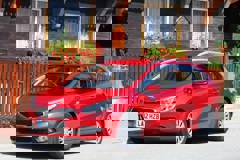
As with the five-door variant, the front is distinguished by Hyundai’s hexagon-shaped grille and jewel-like headlamps, but from the B-pillar backwards the wagon differs significantly. The roofline extends rearwards over the flexible passenger/cargo area, sloping to add dynamism to the car’s stance in keeping with the fluidic sculpture ethos of a stationary car appearing to be in motion.
Further enhancing the wagon’s dynamic appearance, a pronounced swage line runs horizontally along the sides of the body and rises all the way to the rear lights. The rear windscreen wraps around the D-pillars, increasing interior luminosity and benefiting visibility. The deep tailgate gives the car a clean look and opens to bumper-level for easy loading.
Buyers of the New Generation i30 wagon will benefit from Five Year Triple Care, comprising a five-year unlimited warranty, five years’ roadside assistance, and five years of vehicle health checks.
March 2012
Hyundai suggest that the i30 may get a new turbocharged 1.2 T-GDI Kappa engine. This unit is not yet confirmed for application in a production vehicle, but would be well suited to a B / C segment car. Key facts: Displacement 1248cc 4-cylinder, T-GDI, DOHC 16v Direct injection CO2 emissions less than 110 g/km.
What to watch out for
From 2015 model year i30 was fitted with larger brake callipers that preclude the fitting of 15-inch wheels and 205/65 R15 tyres.
08-05-2016:Manual transmission failure reported on 2014/64 reg Hyundai i30 1.6 CRDI Tourer soon after 20,000 mile service. Dealer said one of the synchro rings had failed and needed replacing, then bearings needed replacing.
