
Jaguar XKR (2006 – 2015) Review
.jpg?width=640&height=426&rmode=crop)
.jpg?width=640&height=426&rmode=crop)
.jpg?width=640&height=426&rmode=crop)
.jpg?width=640&height=426&rmode=crop)
.jpg?width=640&height=426&rmode=crop)
.jpg?width=640&height=426&rmode=crop)
.jpg?width=640&height=426&rmode=crop)
.jpg?width=640&height=426&rmode=crop)
.jpg?width=640&height=426&rmode=crop)
.jpg?width=640&height=426&rmode=crop)
.jpg?width=640&height=426&rmode=crop)
.jpg?width=640&height=426&rmode=crop)
.jpg?width=640&height=426&rmode=crop)
.jpg?width=640&height=426&rmode=crop)
.jpg?width=640&height=426&rmode=crop)
.jpg?width=640&height=426&rmode=crop)
.jpg?width=640&height=426&rmode=crop)
.jpg?width=640&height=426&rmode=crop)
.jpg?width=640&height=426&rmode=crop)
.jpg?width=640&height=426&rmode=crop)
.jpg?width=640&height=426&rmode=crop)
.jpg?width=640&height=426&rmode=crop)
.jpg?width=640&height=426&rmode=crop)
.jpg?width=640&height=426&rmode=crop)
.jpg?width=640&height=426&rmode=crop)
.jpg?width=640&height=426&rmode=crop)
.jpg?width=640&height=426&rmode=crop)
.jpg?width=640&height=426&rmode=crop)
.jpg?width=640&height=426&rmode=crop)
.jpg?width=640&height=426&rmode=crop)

Jaguar XKR (2006 – 2015) Verdict

 Understated yet purposeful styling. Stunning performance from supercharged V8. Amazingly quick yet refined. XKR-S takes it into another league.
 Only comes with an automatic gearbox. Other high performance sports cars are more driver focussed.
Find out more about the Jaguar XKR (2006 – 2015)
Sitting at the top of the Jaguar performance range is the thunderous XKR - the supercharged version of the standard XK. It really is a very special car with stunning performance, great muscular looks and an elegant interior. As feelgood factor cars go - the XKR is right up there with the best - this is a car that always makes you feel special every time you get behind the wheel.
Much of that feel comes from the superb interior with its high-quality craftmanship feel and stylish design. It's incredibly refined and that translates to the rest of the car. Power comes from a supercharged V8 engine which was originally a 4.2-litre with 420PS but as if that wasn't enough, it was upgraded to a new 5.0-litre unit in March 2009 when the XKR was revised.
This larger engine delivers an astonishing 510PS along with a hefty 625Nm of torque so it's no surprise that 0-60mph comes up in just 4.6 seconds. The engine sounds great too with a deep V8 growl accompanying acceleration, but it's the effortless way the XKR builds speed which is most impressive.
It handles superbly as you'd expect, with great poise and precision. It's quite large for a two-seater sports car, most of it accounted for by the large bonnet, but in corners it feels incredibly nimble with immense grip. The only slight letdown is the steering which could do with more feel, but this doesn't detract from what is a great performance car. It's also equally at home on the motorway where it cruises smoothly, or even in traffic where it's docile and easy to drive.
The XKR is available as a Coupe or a Convertible, allowing you to enjoy that great engine noise even more. The Convertible hood is incredibly well insulated, so much so that with it up, you'll easily forget you're in a soft-top. Other changes in 2009 saw the interior upgraded, including the trademark JaguarDrive Selector - the dial gear lever control which rises out of the central console - another wonderful touch.
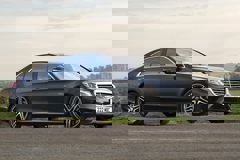
And in August 2010, Jaguar introduced Speed Pack for the XKR. This removes the 155mph maximum speed limit, allowing the XKR to an electronically controlled speed of 174mph. That's unlikely to be much use (especially in the UK) but the pack does include styling extras and the choice of unique colours, allowing you to make your XKR really stand out, as our pictures show.
However the ultimate model is the XKR-S which was launched in 2011. With 550PS and a 0-60mph time of just 4.2 seconds there's no doubting its thunderous performance.
Reviews for Jaguar XKR (2006 – 2015)'s top 3 rivals

.jpg?width=240&height=160&rmode=crop)

.jpg?width=240&height=160&rmode=crop)

Jaguar XKR (2006 – 2015) handling and engines
- Engines range from 4.2 V8 to 5.0 V8 550
- Readers report Real MPG to be between 16–26 mpg
As you'd expect from the high performance version of the Jaguar XK, the XKR isn't exactly short on power. It was originally powered by a 4.2-litre V8 engine - the same one that's used in the standard XK - but thanks to a supercharger, it delivers an extra 120bhp to give a hefty 420bhp in total. Add to this 560Nm of torque and it's not hard to see why the XKR manages to go from 0-60mph in just 4.9 seconds.
But as if that wasn't good enough, this engine was replaced in March 2009 when the 'new generation' XK and XKR models were launched. The capacity of the supercharged V8 engine grew to 5.0-litres and power increased to a truly immense 510bhp along with 625Nm of torque. While the previous 4.2-litre was hardly slow, this newer version does feel slightly quicker and responds quicker to throttle inputs, making it more enjoyable to drive on demanding roads.
Acceleration from 0-62mph takes a mere 4.6 seconds for both the Coupe and the Convertible models, but it's the acceleration from 50-70mph (a much better measure of real world performance) that is amazing, taking just 1.9 seconds. It's unbelivably effortless and gains speed amazingly easily, so you'll often find yourself going faster than you think you are. The V8 also sounds great too, helped by the quad exhaust tailpipes which provide a great deep roar under hard acceleration and burble away on tick over.
Thanks to uprated performance brakes, the XKR also stops as well as it accelerates, although in traffic it can often be difficult to come to stop smoothly as the brake pedal isn't particularly progressive. But aside from this, it's a very easy car to live with day to day and is as happy in slow moving traffic as it is roaring along country lanes.
The standard gearbox is an excellent six-speed electronic automatic with paddle shifts on the steering wheel. In normal mode it works very well, providing seamless and quick shifts, while in sport it's a bit more aggressive and gives the XKR more bite when you fancy some fun.
When it comes to handling the rear-wheel drive XKR is everything you'd expect with amazing grip, great balance and genuine agility in corners. It may feel like quite a big car from behind the wheel (mainly due to that long bonnet), but it's not cumbersome on the move with a delicacy to the handling that belies its size. Body roll is minimal so that only minor criticism is that the steering could do with more feel as it's a little lifeless at times. But at higher (Autobahn type) speeds, the XKR is amazingly stable and composed. It even rides pretty well considering this is a high performance motor with 20-inch wheels fitted as standard.
2011 models (on sale from late 2010) get a new Active Differential Control (ADC) system, designed to give improved traction and dynamic stability. This is an electronically controlled differential which continuously adapts to both the driver's demands and the amount of grip available at each individual wheel.
Operated by an internal electric motor and ‘ball-and-ramp' mechanism, the differential contains a multiplate clutch which transmits or ‘vectors' torque to the wheel with most grip and therefore maximises the car's traction. The multi-plate clutch assembly is designed to prevent excessive differential slip, but differs fundamentally from a conventional traction control system, which uses the brakes to counteract differential slip, after it has occurred.
| Engine | MPG | 0-62 | CO2 |
|---|---|---|---|
| 5.0 V8 | 25 mpg | 5.3 s | 264 g/km |
| 5.0 V8 385 | 25 mpg | 5.2 s | 264 g/km |
| 5.0 V8 510 | 23 mpg | 4.6–4.8 s | 292 g/km |
| 5.0 V8 550 | 23 mpg | 4.2–4.4 s | 292 g/km |
Real MPG average for the Jaguar XKR (2006 – 2015)

Real MPG was created following thousands of readers telling us that their cars could not match the official figures.
Real MPG gives real world data from drivers like you to show how much fuel a vehicle really uses.
Average performance
92%
Real MPG
16–26 mpg
MPGs submitted
44
Jaguar XKR (2006 – 2015) interior
- Boot space is 200–330 litres
| Dimensions | |
|---|---|
| Length | 4791–4804 mm |
| Width | 1892–2028 mm |
| Height | 1312–1329 mm |
| Wheelbase | 2752 mm |
The interior of the XKR manages to blend modern styling with a classic Jaguar feel and the result are a real success. It's very well equipped as standard as you'd expect given that it is the top XK model. There is real attention to detail evident throughout and a feeling of quality craftmanship about the cabin which has an elegant but purposeful feel.
Both the Coupe and Convertible versions of the XKR use Jaguar's lightweight aluminium architecture, which means that as well as being very light, the body shell also has great torsional strength. And that exceptional rigidity, with or without a fixed roof, means creak and rattle-free refinement, even on unforgiving surfaces. It's certainly one of the most refined performance cars around and the Convertible is mightily impressive - in fact with the roof up you'll often think you're in a coupe it's that quiet.
The convertible's triple-lined fabric roof gives a level of fit and stability, even at very high speeds, that minimises wind noise and other road noise plus it includes a luxurious Sudeecloth headlining so it's indistinguishable from a normal fixed roof.
The folding roof can be powered up or down at the touch of a button in less than 18 seconds. And when it is lowered, the convertible's flush-folding hood retracts completely into the bodywork behind the rear seats, under a smooth cover that retains the elegant, sporting lines of the car.
In 2009 when the new generation XKR was launched, the interior was also given a considerable overhaul, bringing it more into line with the design of the Jaguar XF. The most notable change is the introduction of what's known as the JaguarDrive Selector - the dial like gear lever that slides up out of the central console. It adds a more modern touch to the interior and is a much sleeker alternative to the traditional gear lever used before.
Elsewhere the three-spoke steering wheel has a leather-wrapped lower spoke, and Jaguar's striking ‘growler' badge. The XKR's instruments further emphasise its performance character with red pointers, while the XKR also adopts a new white illumination for their instruments.
Heated and cooled front seats are standard equipment on the XKR and feature 16-way seat adjustability for both driver and passenger seats, with memory functions and adjustable side bolsters as standard. They're good enough to keep you in place in tight corners, but soft enough to be ideal for long journeys too. There's a wide choice of interior colour options, including a striking combination of Ivory seating with Oyster upper cabin trim and Oyster carpets.
The standard seven-inch touchscreen in the centre console is another great feature. It gives access and control for the climate control, audio, satellite navigation, Bluetooth and for Jaguar's 'Portable Audio Interface' - which are all standard equipment.
The satellite navigation system offers DVD mapping, postcode entry and a traffic message channel but the Portable Audio Interface is the really impressive system as it offers iPod connectivity and the connection of other storage devices through a USB port, to the in-car sound system, with full touchscreen control.
Jaguar XKR (2006 – 2015) models and specs
| Dimensions | |
|---|---|
| Length | 4791–4804 mm |
| Width | 1892–2028 mm |
| Height | 1312–1329 mm |
| Wheelbase | 2752 mm |
| Miscellaneous | |
|---|---|
| Kerb Weight | 1665–1800 kg |
| Boot Space | 200–330 L |
| Warranty | 3 years |
| Servicing | 15000 miles |
| Spare Wheel | |||
|---|---|---|---|
| Standard | Tyre-repair kit | ||
| Costs | |
|---|---|
| List Price | £55,005–£104,520 |
| Insurance Groups | 48–50 |
| Road Tax Bands | M |
| Official MPG | 22.3–25.2 mpg |
| Euro NCAP Safety Ratings | |
|---|---|
| Adult | - |
| Child | - |
| Pedestrian | - |
| Overall | - |
On sale until April 2017
| Cabriolet | |||
|---|---|---|---|
| Version | List Price | MPG | 0-62 |
| 5.0L V8 Signature Auto 2dr | £61,005 | 25.2 mpg | 5.3 s |
| XK 5.0L V8 Dynamic R Supercharged Auto 2dr | £76,005 | 23.0 mpg | 4.6 s |
| XKR-S 5.0L V8 Supercharged Auto 2dr | £104,520 | 23.0 mpg | 4.2 s |
| Coupe | |||
|---|---|---|---|
| Version | List Price | MPG | 0-62 |
| 5.0L V8 Signature Auto 2dr | £55,005 | 25.2 mpg | 5.2 s |
| XK 5.0L V8 Dynamic R Supercharged Auto 2dr | £70,005 | 23.0 mpg | 4.6 s |
| XKR-S 5.0L V8 Supercharged Auto 2dr | £97,520 | 23.0 mpg | 4.2 s |
On sale until January 2015
| Convertible | |||
|---|---|---|---|
| Version | List Price | MPG | 0-62 |
| 5.0 Dynamic R Convertible V8 510 2dr Auto | £75,975 | 23.0 mpg | 4.8 s |
| 5.0 R-S Convertible V8 550 2dr Auto | £104,490 | 23.0 mpg | 4.4 s |
| Coupe | |||
|---|---|---|---|
| Version | List Price | MPG | 0-62 |
| 5.0 Dynamic R Coupe V8 510 2dr Auto | £69,975 | 23.0 mpg | 4.8 s |
| 5.0 R-S Coupe V8 550 2dr Auto | £97,490 | 23.0 mpg | 4.4 s |
On sale until December 2008
| Coupe | |||
|---|---|---|---|
| Version | List Price | MPG | 0-62 |
| 4.2 Coupe Auto | £69,505 | - | - |
| Open Car | |||
|---|---|---|---|
| Version | List Price | MPG | 0-62 |
| 4.2 Convertible Auto | £75,377 | - | - |
Model History
- June 2006: New XKR launched
- July 2007: XKR Portfolio introduced
- March 2008: XKR-S launched
- March 2009
- July 2010
- August 2010: Speed Pack added
- February 2011: XKR-S launched
- January 2014: XK Dynamic R introduced
June 2006
New XKR launched
Jaguar launched its new supercharged sports car - the Jaguar XKR - in mid 2006. Building on the excellence of the all-new XK introduced in late 2005, the XKR 'takes the Jaguar experience to new heights.'
Like the normally aspirated XK model, the XKR makes intelligent use of modern technology such as its aluminium monocoque body structure. In addition, an uprated 420bhp supercharged V8 engine and state-of-the-art, six-speed automatic transmission bring it a level of accessible, real-world performance that makes the XKR one of the most impressive, everyday, sporting GT in its class. Enhanced sporting styling cues include a unique front bumper, aluminium-finish grilles and bonnet louvers plus unique 19-inch and 20-inch alloy wheel designs along with a quad-exhaust system.
With 120bhp more power than the normally aspirated 4.2-litre XK, the same strong and stiff aluminium body structure and a six-speed automatic transmission with Jaguar Sequential Shift, the XK is a great blend of performance and dynamics. Producing 420bhp at 6250rpm and 560Nm of torque at 4000rpm it is capable of propelling the Coupe version to 60mph in 4.9 seconds (5.0 seconds for the Convertible) and onto an electronically limited top speed of 155mph.
The Sequential Shift uniquely combines all the speed and involvement of a sequential manual gearbox with the comfort and convenience of a full automatic. The system consists of steering wheel-mounted paddles and a conventional gear selector lever, allowing the driver to switch between three automatic or paddle-operated gearbox modes.
Whereas an automated manual gearbox interrupts the flow of torque during the gearchange ' while the clutch is disengaged ' the Jaguar's gearbox maintains the flow of torque throughout the shifting process. This results in gearchanges that are not only quick, but also remarkably smooth. Gearshifts are achieved in less than 600 milliseconds, from the point at which the driver operates the shift paddle to the point at which the shift is complete.
The three gearbox modes give the driver total flexibility to use the transmission to match whatever driving style he or she chooses. In Drive mode, the gearbox behaves as a conventional automatic, with the software optimised for every day driving conditions providing all the benefits of a best-in-class automatic transmission.
In Sport mode, the gearbox's adaptive software becomes more prevalent, adapting and reacting more dynamically to demanding conditions. This software takes account of the prevailing conditions and driver's inputs and adapts accordingly. For example, it recognises when the car is negotiating a curve, and holds the gear accordingly; Hill Recognition enables the XKR to choose the ratios to optimise the ascent or descent of a hill; the gearbox's software will also match the engine speed precisely to the engine and road speeds, 'blipping' the throttle during rapid downshifts.
Manual mode is activated by simply operating one of the steering wheel-mounted paddles, and delivers a state-of-the-art manual gear shift feel from the automatic transmission. To ensure optimum ride and handling the XKR's springs and dampers are uprated compared to the normally aspirated XK. The front spring rate is increased by 38% and the rear spring rate by 24%.
Because of the inherent strength and stiffness of the chassis, the only significant addition to the XKR's structure is an additional rear suspension brace mounted between the rear damper towers to accommodate the significant increase in rear spring rate. This also allows the Convertible to utilise the same dynamic settings as the Coupe model.
The XKR has a new front bumper, aluminium side vents, bonnet louvres and unique 'XKR' aluminium finish to upper and lower front mesh grilles, aluminium finish to rear signature 'blade', unique 'Jupiter' design 19-inch alloy wheels as standard, with 20-inch 'Cremona' XKR wheel available as an option, black brake callipers with 'R' logo, a quad exhaust system and unique lower bumper
A unique sports seat design with additional lateral support for both the driver and front seat passenger has been added, with an 'R' badge on the headrests, tachometer, steering wheel and gear selector. The design of the standard aluminium interior veneer is also unique to the XKR, featuring a 'weave' pattern. XKR customers can also specify the Luxury Sports interior option which features softgrain leather on the 16-way adjustable seats, instrument panel, door trim and centre console.
July 2007
XKR Portfolio introduced
Offers even greater technology and luxury for those seeking the ultimate sports coupe. Unique exterior revisions include 20-inch polished Cremona five-spoke alloy wheels, polished aluminium side vents and Celestial Black paint.
A host of new additions to the interior further the luxurious look and feel of the XKR Portfolio. A new Engine-Spun aluminium veneer is standard along with a new alloy and leather gearshift selector, soft-grab door handles, contrast stitching throughout the cabin and soft grain leather with warm charcoal seats. The XKR Portfolio also features a new high-performance braking system with 400mm front discs and 350mm rear discs - the largest ever fitted to a production Jaguar.
March 2008
XKR-S launched
The short-lived XKR-S was launched at the Geneva Motor Show in March 2008 and features the 4.2-litre V8 supercharged engine. With recalibrated engine management, the XKR-S reaches an electronically limited top speed of 174mph - 19mph faster than the XKR. This additional performance is made accessible by improved aerodynamics (reduced drag and lift) and unique suspension set-up. Other additions include an Alcon R Performance braking system featuring distinctive red monobloc six-piston callipers carrying the R logo and 400mm diameter brake discs at the front and 350mm discs at the rear.
Each XKR-S includes a Bowers & Wilkins surround sound system with 525W Premium audio, featuring low distortion Kevlar mid-range speakers and aluminium dome speakers, designed and tuned specifically for XK. This limited edition coupé in Ultimate Black is identified by the unique XKR-S badge on the rear of the car.
March 2009
The new generation XKR coupe and convertibles, with all-new V8 engines, deliver more power and performance with greater efficiency for the 2010 Model Year. They also features interior enhancements, advanced lightweight aluminium body structure and a wider range of models, plus the new luxurious 'Portfolio' model.
The all-new AJ-V8 Gen III direct-injection engines are the most advanced and efficient petrol engines Jaguar has ever produced. The XKR features a 5.0-litre supercharged engine delivering 510bhp and 625Nm of torque propelling it to 60mph in just 4.6 seconds. Despite these improvements, fuel economy and CO2 emissions are both lower. Exterior changes include a distinctive and purposeful new front end design, new LED rear lights and a new lower rear body valance. Inside the cabin, it has the exciting, user-friendly JaguarDrive Selector that was first seen on the XF.
July 2010
An exclusive XKR - the XKR 75 - made its debut at the Goodwood Festival of Speed in July 2010. Jaguar engineers increased the power and torque of the 5.0-litre supercharged engine to 530bhp and 655Nm respectively, so the limited edition model's top speed is electronically limited to 174mph and the 0-60mph time is reduced from 4.6 to 4.4 seconds compared to the standard 510bhp XKR.
The XKR 75 features revised suspension and handling for increased precision and agility in addition to the performance enhancements. To ensure the XKR 75 remains stable at high speeds, a revised aerodynamic body pack with a front splitter, side sills extensions, a rear diffuser and larger rear spoiler provide increased balance and a reduction in lift. The XKR's computerised Active Differential Control also adjusts to reduce steering sensitivity at very high speeds, further improving stability and driver control.
There is also an improved acoustics package for the semi-active sports exhaust, the XKR 75 produces a growl to match its performance. The car's driver-focussed character, however, has not been achieved at the expense of the Jaguar traditional values of refinement and comfort.
The XKR 75 features a new Stratus Grey finish. Red brake callipers contrast the 20-inch gloss Vortex forged lightweight alloys with a dark technical finish and diamond turn. Customers will have the option to apply a unique body graphic that runs from the front bumper to the rear haunches. The XKR 75's interior completes the driver-focussed performance environment finished in Charcoal with ivory stitch, piano black finish to facia and centre console and a Jet suedecloth headlining. Production of the XKR 75 will be limited to just 75 vehicles, which were available to order from July 2010.
August 2010
Speed Pack added
The XKR Coupe is now available with an optional Speed Pack, allowing customers to further strengthen their XKR's already impressive breadth of capability, by extending the car's top speed from 155mph (250km/h) to an electronically limited 174mph (280km/h) thanks to a unique engine and transmission recalibration.
To ensure the XKR with Speed Pack remains stable at high speeds, the coupe uses a revised front aerodynamic splitter and larger rear spoiler to provide increased balance and a reduction in lift. The XKR's computerised Active Differential Control also adjusts to reduce steering sensitivity at very high speeds, further improving stability and driver control.
Every XKR with the Speed Pack will come with body-coloured side sills and rear diffuser, and a chrome finish to the window surrounds, upper and lower mesh grilles, side Power Vents and boot lid finisher. Red brake callipers with a Jaguar ‘R' logo sit inside 20-inch Kasuga alloy wheels.
Customers who order the XKR Coupe with the Speed Pack will be offered a paint palette that is part of the Jaguar Designers' Choice programme - a range of colours that have been specifically chosen to compliment the performance potential of the car. Seven colours are available on Speed Pack models - Ultimate Black, Polaris White, Salsa Red, Liquid Silver, Lunar Grey, Kyanite Blue and Spectrum Blue.
For customers looking to create a real statement with their Speed Pack XKR Coupe, the new optional Black Pack allows them to own a bold and purposeful Jaguar with undeniable visual impact thanks to menacing gloss black wheels and exterior detailing.
Available only with the Speed Pack, XKRs fitted with the Black Pack have a paint palette selected from colours that Jaguar's Design team believe to be ideal for creating a coupe with immediate exclusivity. The Black Pack models will be available in Ultimate Black, Polaris White or Salsa Red and boast eye-catching 20-inch gloss black Kalimnos alloy wheels. Further gloss black finishing is applied to the window surrounds and front grilles. Red painted brake callipers contrast strongly with the black alloy wheels, while body coloured front and rear spoilers and boot lid finisher round out the package. Customers also have the option to apply a sweeping ‘XKR' side body graphic that runs along the door sills.
In addition to the Black Pack's exterior changes, the Jaguar Designers' Choice programme has also selected a range of interior trims that support the visual impact of the car. All XKRs with the Black Pack will be trimmed with Charcoal leather hides that can be personalised with a range of colour stitching and grain. Three interior finishes and veneers for the fascia and door trims are also available - Dark Oak, Dark Mesh Aluminium and Piano Black.
February 2011
XKR-S launched
Uprated supercharged V8 engine, overhauled suspension and a new aerodynamically-driven design. The XKR-S engine offers 550PS and 680Nm of torque, enough for a top speed of 186mph (300km/h). 0-60mph 4.2 seconds, 0-100mph 8.6 seconds.
The XKR-S is not merely the quickest Jaguar ever, but also the most agile, responsive and driver-focused. It exploits the XK’s strong, lightweight aluminium body architecture to maximise both handling and economy. Alongside its incredible performance, the XKR-S is the only car in its class that emits less than 300g/km CO2. Bespoke suspension changes to the front and rear offer ultimate precision, control and driver appeal, while a reprogrammed Adaptive Dynamics system allows the enthusiastic driver to explore the edges of the handling envelope.
| ENGINE AND TRANSMISSION | |
| Engine Capacity (litres) | 5.0 |
| Engine Capacity (cc) | 5000 |
| Cylinders | 8 |
| Valves per Cylinder | 4 |
| Compression Ratio | 9.5:1 |
| Bore/Stroke (mm) | 92.5/93.0 |
| Bore/Stroke (inches) | 3.64/3.66 |
| Final Drive Ratio | 3.31:1 |
| Transmission | 6-speed automatic |
| 1 st | 4.17:1 |
| 2 nd | 2.30:1 |
| 3 rd | 1.52:1 |
| 4 th | 1.14:1 |
| 5 th | 0.87:1 |
| 6 th | 0.69:1 |
| Rev | 3.40:1 |
| PERFORMANCE | |
| 0-60mph (seconds) | 4.2 |
| 0-100kph (seconds) | 4.4 |
| 0-100mph (seconds) | 8.7 |
| 100-180kph (seconds) | 7.6 |
| Top Speed (mph/kph) | 186/300 |
| Max. Power (BHP@rpm) | 542 |
| Max. Power (PS@rpm) | 550 |
| Max. Power (KW@rpm) | 405 |
| Power to Weight Ratio (BHP/ton) | 309 |
| Power to Weight Ratio (PS/tonne) | 314 |
| Torque (lb ft@rpm) | 502 |
| Torque (Nm@rpm) | 680 |
| Torque to Weight Ratio (lb-ft/ton) | 286 |
| Torque to Weight Ratio (Nm/tonne) | 388 |
| Aerodynamics (Cd) | 0.34 |
| ECONOMY | |
| Urban (mpg) | 15 |
| Urban (l/100km) | 18.9 |
| Extra Urban (mpg) | 33 |
| Extra Urban (l/100km) | 8.6 |
| Combined (mpg) | 23 |
| Combined (l/100km) | 12.3 |
| City EPA | 15 |
| Highway EPA | 22 |
| US C-H Combined (US mpg) | 17 |
| Fuel Tank Capacity (litres) | 74.0 |
| NEDC Combined CO2 (g/km) | 292 |
| DIMENSIONS | |
| Wheelbase (inches) | 108.3 |
| Wheelbase (mm) | 2752 |
| Front Track (inches) | 61.4 |
| Front Track (mm) | 1560 |
| Rear Track (inches) | 63.3 |
| Rear Track (mm) | 1608 |
| Overall Length (inches) | 188.7 |
| Overall Length (mm) | 4794 |
| Overall Width excl. mirrors (inches) | 74.5 |
| Overall Width excl. mirrors (mm) | 1892 |
| Overall Height (inches) | 52.0 |
| Overall Height (mm) | 1312 |
| Turning Radius (metres) | 10.9 |
| WEIGHT | |
| EU: Kerb Weight (lbs) | 3865 |
| EU: Kerb Weight (kg) | 1753 |
| Federal: Lightest Weight (lbs) | 3968 |
| Gross Vehicle Weight (kg) | 1800 |
January 2014
XK Dynamic R introduced
The performance focused 510PS 5.0-litre supercharged XK Dynamic R – based on the existing XKR – offers Black Dynamic Pack, which incorporates XKR-S suspension and dynamics and a 10mm reduction in ride height, plus Speed Pack, which equips the car with an Aerodynamic Pack and an increased top speed of 174mph. A Performance Active Exhaust is also standard equipment. First deliveries to UK customers of the new XK Signature and Dynamic R editions are expected in March.
The XK Dynamic R’s 5.0-litre supercharged V8, offers power and torque figures of 510PS and 625Nm respectively, taking the car to 60mph in just 4.6 seconds with a limited top speed of 174mph. The XK Dynamic R emits 292g/km.
The supercharged XK Dynamic R edition also benefits from Jaguar's Active Differential Control technology. This uses a multiplate clutch to vector torque to the driven wheel with the most grip. Allied to ABS and stability control, this allows for the ultimate in traction and precision both mid-corner and at its exit. The XK Signature model uses a mechanical differential, which delivers outstanding levels of grip and stability under power.
The XK Dynamic R boasts Jaguar’s new diamond sewn Performance seat in either Ivory/Charcoal soft grain leather with Ivory contrast stitch or Charcoal/Red soft grain leather with Red contrast stitch leather. Featuring integrated head restraints and increased lateral and squab support, the new seats hold driver and passenger securely and comfortably in place. The 16-way adjustment of squab, cushion, lumbar and bolster elements is supplemented by memory and heating functions. The interior Jet Suedecloth headliner is complemented with Piano Black veneers. Bright Metal sport pedals are also fitted as standard.
It has 20-inch Vortex diamond turned wheels – with distinctive Red painted brake calipers – and the option of 20-inch Vulcan Gloss Black lightweight alloys.
What to watch out for
One owner's faults found in nine months of ownership were: three flat batteries, a door that no longer meets the rest of the bodywork, a bulging rear brake light, an inoperative convertible top, a blown in front grille and a bent radio aerial.
On 2006 cars the aluminium doors can oxidise at the bottom.
One reader needed new supercharger drivebelt after 3 years and 22k miles, then suffered diff failure.
31-05-2011:Water in footwell can be due to pinched drain from the a/c condenser, but space is so tight it cannot be rectified without removing the transmission.
09-06-2012:Report of total instrument cluster screen failure on a 22,000 mile 2006 XK 4.2. Quoted £1,600 to repair, but Jaguar stepped in and paid half.
13-03-2013:2007 XKR required new cataltic converters at 48,000 miles as cost of £1,600.
18-06-2014:Another report of touch screen failure, this on a 30,000 mile Jaguar XK. Quoted £800 for an exchange screen or £1,200 for a new one, plus £400 labour to fit (final bill with VAT was £1,400).
05-05-2015:Battery drains on XKs and XFs can be caused by the electric parking brake not being properly applied as well as the interior light delay and the Blueooth searching for a paired phone if the car has not been double locked.
10-06-2015:Recurrent problems with media system of 26k mile 2013 Jaguar XKR. System freezes and gives no sound. Dealer has tried some software updates and replaced the audio module, but system remains faulty.
30-05-2017:Report of 2014 XKR, regularly serviced, going into limp mode when owner pulled out to overtake at start of a dual carriageway. Might have been protecting itself against sudden overfuelling?
14-07-2019:Report of 2007 Jaguar XKR permanently displaying a 'Check Pedestrian Safety' warning sign complete with little red triangle. Possibly triggered by a speed hump or pothole. Needs SRS resetting.
