
Best small hybrid car 2022
The best small hybrid cars are some of the new car market’s greatest all-rounders. Indeed, they are already guaranteed a strong following, because superminis, family hatchbacks and small SUVs are Britain’s favourite types of car.
Hybrid cars add great fuel economy and low CO2 emissions to the mix, making them even cheaper to run and better for the planet.
Although they may cost more than their conventional non-hybrid equivalents, the benefits in terms of running costs soon start to pay off. Plus, as they’re already prepared for the petrol and diesel ban from 2030, greater retained values mean they’re still competitively priced in terms of monthly finance payments.
The diversity even at this end of the market is enormous. In our guide to the best small hybrid cars, we’re looking at both conventional hybrids and plug-in hybrid cars, the latter which offer a greater range of pure electric driving.
Hybrid technology is cheaper than a plug-in hybrid setup, and works well if you don’t have off-street parking or easy access to electric car charging facilities. This technology is sometimes referred to as a ‘self-charging’ hybrid.
Plug-in hybrids, meanwhile, are a great introduction to pure electric motoring. Indeed, so generous is the electric range of even the smallest plug-in hybrids, many find there’s more than enough to complete their daily driving in pure EV mode.
Note, all the cars here are genuine hybrids. We haven’t included mild hybrids, as this technology is more of an extended stop-start system, rather than one that actually drives cars using electric power.
Best small hybrid cars
|
.jpg?width=620)
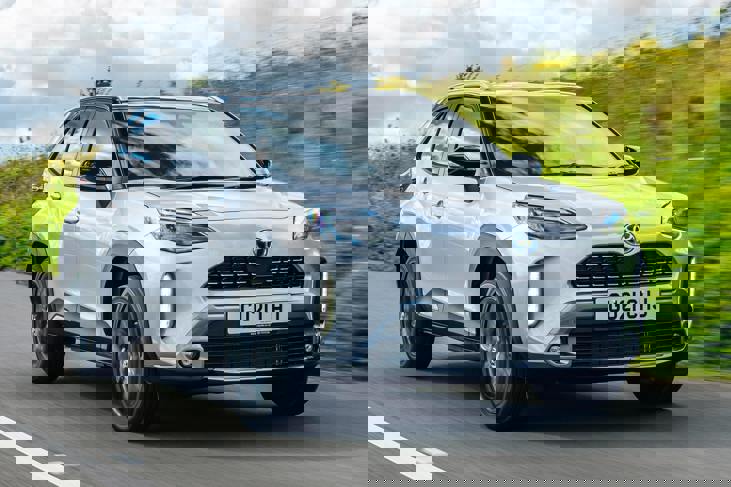
Toyota Yaris
The popular Toyota Yaris is the Japanese company’s best-selling car here in the UK, and a regular fixture of the monthly top 10 car sales chart. The latest version is better than ever, combining genuinely striking, hot hatch-like styling with sub-four-metre length and decent room inside. It has five doors as standard, along with a 286-litre boot. The 1.5-litre hybrid drivetrain is smooth and efficient, and owners report being amazed at how far this ‘self-charging hybrid’ will travel in pure electric mode. It’s not uncommon for more than half an average city trip to be driven in EV mode, with corresponding benefits to overall fuel economy.
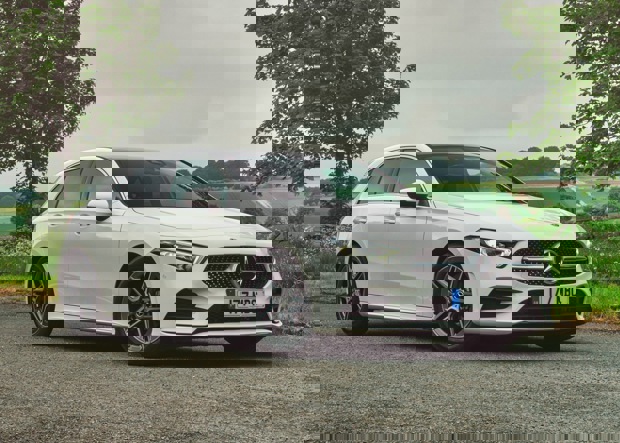
Mercedes-Benz A-Class
The Mercedes-Benz A-Class is a family hatchback favourite here in Britain. Last year, it even outsold the Ford Focus – helped by a compelling set of stats for the plug-in hybrid A 250 e variant. This model combines 215hp and 0-62mph in 6.6 seconds with an official fuel economy of more than 250mpg, plus a pure electric range of up to 44 miles. A powerful 15.6kWh battery is behind this wizardry; if you’re able to charge it overnight, the 1.3-litre turbocharged petrol engine may rarely start up in everyday driving. The Mercedes is very popular with company car drivers, and for good reason. It’s so efficient, they can save a small fortune in Benefit-in-Kind tax payments.
.jpg?width=620)
Honda Jazz
The latest Jazz infuses Honda’s long-running, ultra-practical five-door supermini with some of the cute, quirky styling of the pure electric Honda e city car. The Jazz uses an innovative twin-motor hybrid system, which is so clever, it doesn’t even need a regular gearbox. The petrol engine instead powers a generator, which drives another motor to turn the wheels. This means the Jazz has the ability to shut down its engine even at motorway speeds. Result: plenty of pure electric motoring and excellent fuel economy. It remains incredibly roomy inside, too, with acres of passenger space front and rear, plus the brilliant Honda Magic Seats that turn this compact hatchback into something akin to a small van.
.jpg?width=620)
SEAT Leon e-Hybrid
The SEAT Leon e-Hybrid is a surprisingly affordable plug-in hybrid family hatchback with a dash of Spanish style. It uses a 1.4-litre TSI turbocharged engine in combination with an electric motor, plus a battery big enough to give a pure electric range of 40 miles. Company car drivers will love the resultant low tax bills, particularly as the system has an overall power of 204hp – almost hot hatch territory. If you have a wall box, the battery can be recharged from flat in four hours; but even if you have to rely on a three-pin plug, it can still charge in five hours. The sporty dynamics of the Leon mean it’s enjoyable to drive as well, particularly if you pick good-looking FR or FR Sport trim.
.jpg?width=620)
Toyota Corolla
The Corolla is a long-running hybrid that uses the same technology as the famous (and more expensive) Toyota Prius. Available in 1.8-litre and more powerful 2.0 forms, the Corolla hybrid is big on old-fashioned common sense. It’s roomy, reliable, well-equipped, good on fuel and will amaze everyday drivers with its pure electric range – even though it never has to be plugged in. Toyota has also given the latest Corolla sharper and sportier styling than before, making it a more visually interesting car to have parked on your driveway.
.jpg?width=620)
Renault Captur E-Tech
Renault offers the Captur in a choice of E-Tech variants – either conventional hybrid or plug-in hybrid. The former is cheaper, and provides a welcome lift in fuel economy over the conventional Captur. The E-Tech plug-in hybrid uses its bigger battery to significantly expand the car’s electric range to 32 miles. The 9.8kWh battery can be changed in a few hours using a regular domestic plug socket, too. But although the plug-in hybrid is much more efficient, it does cost significantly more upfront. It’s worth doing the sums to see which Captur is best for you.
.jpg?width=620)
Honda HR-V
The new Honda HR-V small SUV is a strikingly futuristic design, one that has come on leaps and bounds from its predecessor. Now a pure hybrid, it uses the same clever e:HEV twin-motor technology as the Honda Jazz. Able to switch into pure electric mode with impressive regularity, the HR-V has CO2 emissions of 122g/km, plus official fuel economy of more than 52mpg. Just as striking is the HR-V’s spacious and very flexible interior, which now has an almost premium level of fit and finish. To show the attention to detail that’s gone into it, Honda’s even created a new type of air vent that delivers a comfortable ‘diffused’ flow of air to passengers.
.jpg?width=620)
Toyota Yaris Cross
The Toyota Yaris Cross is the small SUV alternative to the Yaris hatchback. It uses the same three-cylinder petrol engine and ‘self-charging’ hybrid system in combination with a CVT automatic gearbox. This gives everyday fuel economy touching 60mpg, plus the ability to travel for a surprising distance in pure electric mode – particularly around town. The Yaris Cross is another great example of Toyota space efficiency, with compact dimensions on the outside but a practical and flexible cabin within. It’s a good looking car, with more than a few SUV styling cues from the larger and more rugged RAV4 range.
.jpg?width=620)
Renault Clio E-Tech
The Clio is available with an affordable hybrid system, which Renault calls ‘E-Tech hybrid’. It combines an efficient 1.6-litre petrol engine with a self-charging hybrid setup. There’s also a snappy gearbox inspired by Renault’s involvement in F1 motor racing. It’s really clever technology, which feels good to drive, yet also serves up 50mpg or more in everyday use. If you’re easy on the accelerator, you’ll be surprised at how far you can travel without the engine kicking in. The technology further enhances the likeable Clio supermini, which is pretty and elegant to look at, and has a plush and comfortable interior.
.jpg?width=620)
Audi A3 TFSI e
The Audi A3 TFSI e is a premium plug-in hybrid version of the firm’s popular family hatchback. In 40 TFSI e guise, the combination of a 1.4-litre turbocharged engine and an electric motor produces 204hp, for 0-62mph in 7.6 seconds (and 0-37mph in a brisk 5.2 seconds in pure electric mode). The battery has enough capacity for a driving range of up to 40 miles, although if you choose S line trim – with its larger and sportier alloy wheels – this drops to 37 miles. Virtually indistinguishable from a regular A3, the TFSI e inherits the core car’s upmarket look, high-tech interior and impressive feeling of quality.
Are small hybrid cars worth it?
Proportionally, adding hybrid technology to a small, more affordable car does hike prices more than on a pricier vehicle. The effect is magnified further when you’re looking at more expensive plug-in hybrid technology. But even if you only cover an average mileage, the reduction in running costs will save you a small fortune on fuel. For many, small hybrid cars certainly are worth it overall.
What is the cheapest small hybrid car?
The cheapest small hybrid cars use regular ‘self-charging’ hybrid technology rather than a plug-in hybrid system. Such cars include the Toyota Yaris, Renault Clio and Honda Jazz, along with their small SUV alternatives the Toyota Yaris Cross, Renault Captur and Honda HR-V. All are affordable – and notably more effective in terms of reducing fuel bills than more limited ‘mild hybrid’ technology.
Can I buy a small hybrid car as a plug-in hybrid?
The very smallest supermini hybrid cars are not yet available as plug-in hybrids. As mentioned, they would prove rather more expensive than is normal in this sector, due to the extra cost of the bigger batteries – prohibitively so in most cases. The Renault Captur is the sole exception to this, as it comes in both E-Tech hybrid and plug-in hybrid forms. However, the price jump between the two is rather steep, which could limit the popularity of the plug-in hybrid compared to its self-charging sibling.
