
Hyundai i40 Tourer (2011 – 2019) Review
.jpg?width=640&height=426&rmode=crop)
.jpg?width=640&height=426&rmode=crop)
.jpg?width=640&height=426&rmode=crop)
.jpg?width=640&height=426&rmode=crop)
.jpg?width=640&height=426&rmode=crop)
.jpg?width=640&height=426&rmode=crop)
.jpg?width=640&height=426&rmode=crop)

Hyundai i40 Tourer (2011 – 2019) Verdict

 Good quality and fairly stylish for an estate. Plenty of standard equipment. Comfortable ride. Economical diesel engines
 Awkward boot shape. Lacklustre image
Find out more about the Hyundai i40 Tourer (2011 – 2019)
The Hyundai i40 Tourer is Hyundai doing what it does best. A good quality, good value car that appeals to the left side of the brain rather than the right. In other words, if you made a big checklist of all the things that are good about the Hyundai i40 Tourer you’d come up with a desirable car, yet you’d never actually write 'desirable' as one of its traits.
Initially the i40 Tourer was only one engine, a 1.7-litre diesel in three versions - 115PS, 136PS and 141PS. This was replaced by a 1.6 CRDi diesel late in 2018, while a 1.6-litre GDi petrol was also introduced. One thing all these engines have in common is impressive fuel economy - with the latest diesels capable of a combined 54.3mpg under WLTP tests.
The car was launched in 2012 with trim levels called Active, Style and Premium, but a 2015 update changed that to S, SE Nav, SE Business and Premium. All cars get alloy wheels, Bluetooth and air conditioning plus you only need jump one grade to SE Nav for a full colour touchscreen multimedia setup and climate control – this is a well-equipped car, far from ‘low budget’ in that respect.
Cabin quality is excellent throughout, with good use of soft-touch plastics for the upper dash and door trim plus glossy black trim even for base models. Some of the dials and buttons are flimsy and the dashboard design occasionally falls into the 'trying too hard' category with its swoopy creases, but overall the i40 Tourer has a quality feel.
So, it’s well-equipped, spacious, high quality and the numbers stack up. But what the i40 Tourer lacks is any sense of fun. Granted, fun is rarely a priority for estate buyers if you believe the cliche, but everything about the i40 Tourer just does a decent job – no more, no less.
Reviews for Hyundai i40 Tourer (2011 – 2019)'s top 3 rivals
.jpg?width=240&height=160&rmode=crop)

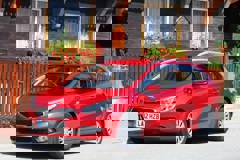
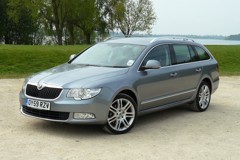
Hyundai i40 Tourer (2011 – 2019) handling and engines
- Engines range from 1.6 GDi Blue Drive to 2.0 GDi
- Readers report Real MPG to be between 32–62 mpg
The i40 Tourer is set up primarily for comfort, so the suspension is on the soft side, the steering is very light and the car very effectively shuts out road, wind and engine noise at higher speeds. That all means it’s far better on the motorway than it is around town or anywhere else – involving to drive the i40 Tourer is not.
It’s worth noting that there’s a big difference in feel between the torque convertor automatic gearbox available with the older EU5 136PS engine and the dual-clutch automatic (DCT) with the later 141PS unit. The former is a real weakness, sapping the life out of the engine and coming with a significant fuel economy penalty, sinking it to a 47.1mpg average from 62.8mpg with a manual.
The more modern DCT is a far better driving experience – quicker to chenge gear and with better low range engine response – but surprisingly it too reduces economy, albeit not as drastically, dropping it to 56.5mpg. By comparison, a 150PS 2.0-litre Volkswagen Passat estate specificed with a twin-clutch DSG will return 62.8mpg, which is only a few miles per gallon less than the manual.
One thing you’re guaranteed with any i40 is a lack of pace, with no variant of the sole 1.7-litre diesel getting below a double figure 0-62mph time. As with much about the i40 though, numbers only tell half the story because, in fact, even the 115PS unit has a healthy 260Nm torque at just 1250rpm, while the 141PS unit has 340Nm at 1700rpm.
To a greater or lesser extent in both cases, there’s a surge of acceleration from the off, but it rapidly tails off. It means a lot of gear changing around town with a manual, but that’s no real hardship because the i40 Tourer has a light, pleasant gear shift action.
Light is the best way to describe the steering too, giving the car a feeling of low-speed agility that belies its length – at 4.8 metres this is a long estate. Sadly it also provides almost zero information about the relationship between the wheels and the road, making for especially numb cornering sensation.
But do you care about that? Because in every other way this is a very pleasant estate car. There’s surprisingly little chugging from the diesel engine and the car’s combination of an excellent, quite low-slung driving position, supportive seats and supple driving position make it pretty relaxing transport.
| Engine | MPG | 0-62 | CO2 |
|---|---|---|---|
| 1.6 GDi | 43 mpg | 11.6 s | 155 g/km |
| 1.6 GDi Blue Drive | 47 mpg | 11.6 s | 140 g/km |
| 1.7 CRDi 115 Blue Drive | 66 mpg | 12.9 s | 113 g/km |
| 1.7 CRDi 136 | 55 mpg | 10.6 s | 134 g/km |
| 1.7 CRDi 136 Automatic | 47 mpg | 12.0 s | 159 g/km |
| 1.7 CRDi 136 Blue Drive | 63 mpg | 10.6 s | 119 g/km |
| 2.0 GDi | 39 mpg | 9.7 s | 169 g/km |
Real MPG average for the Hyundai i40 Tourer (2011 – 2019)

Real MPG was created following thousands of readers telling us that their cars could not match the official figures.
Real MPG gives real world data from drivers like you to show how much fuel a vehicle really uses.
Average performance
78%
Real MPG
32–62 mpg
MPGs submitted
211
Hyundai i40 Tourer (2011 – 2019) interior
- Boot space is 553–1719 litres
- Euro NCAP rating of five stars
| Dimensions | |
|---|---|
| Length | 4770 mm |
| Width | 1815 mm |
| Height | 1470 mm |
| Wheelbase | 2770 mm |
In volume terms the i40 Tourer has a quantifiably large boot at 553 litres, stretching out to 1719 litres with the rear seats folded down (which have a 60/40 split as standard). That compares favourably to the 500 to 1605 litres of cargo space of the Ford Mondeo estate.
Unfortunately the boot is awkwardly shaped because of the amount that the rear suspension encroaches into it at either side. That does mean the spaces in front of them can be sectioned out as useful storage pockets, but it’s a hindrance to the loading of large objects – as is the fact that the rear seats don’t fold entirely flat. The floor is flush with the boot lip, at least and there’s some under-floor storage.
With the rear seats up the i40 offers plenty of rear knee space, though the swoopy styling means headroom is limited for taller adults. Rear seat passengers will find storage limited to a couple of nets on the front seat backs and shallow door pockets.
Up front it’s much better, with a large central storage bin, a big glove compartment and deeper storage spaces in the doors. The covered receptacle in the dashboard is surprisingly large too and a good way of neatly storing fuel receipts and such.
The i40 Tourer’s dash is mostly intuitive despite looking a little haphazard owing to all those buttons – some of which are in unusual places. But because they’re all clearly labelled, it’s easy to work your way around them.
The touchscreen media system of SE Nav versions and above is one of the easier ones to use too, because there are physical buttons for all the main functions, meaning you’re not endlessly navigating back and forth through sub-menus.
In terms of specifications, you really could make do with a base level S car if you’re not fussed about the navigation, but in a car like this we’d say it's better to have one – it improves the cabin ambience and the used car value, if nothing else.
Other kit that makes SE Nav appealing includes a heated steering wheel, heated front seats, electric adjustment for the driver’s seat and electric heated door mirrors, while DAB radio comes with the nav system and there are parking sensors all round.
SE Business takes things up a notch, naturally, including part-leather ventilated seats, parking sensor displays and keyless smart entry with a start-stop engine button.
Finally, Premium adds features like a full-colour instrument display between the driver dials, heated rear seats and alloy pedals. It’s worth noting that Premium gets a couple of extra safety features too, including two extra arbags, with a pair of rear side ones adding to the seven that are standard, and a lane departure warning system. Premium cars are distinguished by 18-inch alloy wheels and satin chrome trim.
The i40 was awarded a five-star safety rating by Euro NCAP, with especially impressive 92 per cent and 86 per cent scores for adult occupant and child occupant safety especially. That said, it’s disappointing that safety equjpment like additional airbags is revserved for top specification models.
Hyundai i40 Tourer (2011 – 2019) models and specs
| Dimensions | |
|---|---|
| Length | 4770 mm |
| Width | 1815 mm |
| Height | 1470 mm |
| Wheelbase | 2770 mm |
| Miscellaneous | |
|---|---|
| Kerb Weight | 1534–1659 kg |
| Boot Space | 553–1719 L |
| Warranty | 5 years / Unlimited miles |
| Servicing | 10000–20000 miles |
| Spare Wheel | |||
|---|---|---|---|
| Standard | Space-saving spare wheel | ||
| Costs | |
|---|---|
| List Price | £18,650–£29,575 |
| Insurance Groups | 12–18 |
| Road Tax Bands | C–H |
| Official MPG | 39.2–65.7 mpg |
| Euro NCAP Safety Ratings | |
|---|---|
| Adult | - |
| Child | - |
| Pedestrian | - |
| Overall | 5 |
On sale until October 2015
| Estate | |||
|---|---|---|---|
| Version | List Price | MPG | 0-62 |
| 1.7 CRDi 115 Blue Drive Active 5dr | £20,355 | 65.7 mpg | 12.9 s |
| 1.7 CRDi 115 Blue Drive Style 5dr | £22,455 | 65.7 mpg | 12.9 s |
| 1.7 CRDi 136 Blue Drive Active 5dr | £21,155 | 62.8 mpg | 10.6 s |
| 1.7 CRDi 136 Blue Drive Premium 5dr | £25,655 | 62.8 mpg | 10.6 s |
| 1.7 CRDi 136 Blue Drive Style 5dr | £23,255 | 62.8 mpg | 10.6 s |
| 1.7 CRDi 136 Premium Auto 5dr | £27,415 | 47.1 mpg | 12.0 s |
| 1.7 CRDi 136 Style Auto 5dr | £25,015 | 47.1 mpg | 12.0 s |
On sale until July 2014
| Estate | |||
|---|---|---|---|
| Version | List Price | MPG | 0-62 |
| 1.7 CRDi 115 Blue Drive Premium 5dr | £24,735 | 65.7 mpg | 12.9 s |
| 1.7 CRDi 136 Blue Drive Premium SE 5dr | £27,815 | 62.8 mpg | 10.6 s |
| 1.7 CRDi 136 Premium SE 5dr | £27,825 | 55.4 mpg | 10.6 s |
| 1.7 CRDi 136 Premium SE Auto 5dr | £29,575 | 47.1 mpg | 12.0 s |
On sale until May 2014
| Estate | |||
|---|---|---|---|
| Version | List Price | MPG | 0-62 |
| 1.7 CRDi 136 Premium 5dr | £25,320 | 55.4 mpg | 10.6 s |
| 1.7 CRDi 136 Style 5dr | £22,920 | 55.4 mpg | 10.6 s |
On sale until March 2013
| Estate | |||
|---|---|---|---|
| Version | List Price | MPG | 0-62 |
| 1.6 GDi Blue Drive Active 5dr | £18,650 | 47.1 mpg | 11.6 s |
| 1.6 GDi Style 5dr | £20,450 | 42.8 mpg | 11.6 s |
On sale until April 2012
| Estate | |||
|---|---|---|---|
| Version | List Price | MPG | 0-62 |
| 2.0 GDi Premium 5dr | £23,795 | 39.2 mpg | 9.7 s |
Model History
- October 2010: Hyundai announces its new saloon will be called i40
- March 2011: New i40 unveiled
- November 2018: Hyundai i40 updated with new engines
October 2010
Hyundai announces its new saloon will be called i40
The i40, which was known by the codename ‘VF' during development, arrived as the company embarked on the next phase of its brand and product evolution in Europe.
Designed at Hyundai’s European R&D facilities in Rüsselsheim, Germany, the new i40 is the company’s first D-segment model to be specifically developed for the European market. The car will progress the ‘fluidic sculpture’ design language, featuring the company’s signature hexagonal front grille and rakish lines which give the i40 a dynamic, sporty appearance by connecting the front, side and rear profiles.
The new i40 will also become Hyundai’s most innovative model on sale in Europe, including the latest environmental technologies developed under the company’s Blue Drive eco-program, and a powertrain line-up which boasts best-in-class performance and fuel economy, and very lowemissions.
The i40 benefits from industry leading Five Year Triple Care package that includes a five-year unlimited mileage warranty, five years’ roadside assistance and five years of vehicle health checks.
March 2011
New i40 unveiled
With the i40, Hyundai set out to make premium quality accessible to everyone, in line with its‘modern premium’ philosophy. A number of features on i40 are not yet available on some competitor cars, including heated, folding rear seats; an auto-defog system that automatically detects and clears mist on the windscreen; and a heated steering wheel.
Furthermore, the i40 demonstrated Hyundai’s commitment to global leadership in eco-friendly technology, with its 1.7-litre ‘U-II’ diesel engine emitting as little as 113 g/km of CO2 – a best-in-class figure. In addition, the ‘Nu’ 2.0-litre petrol engine makes its debut, delivering higher torque for enhanced driveability, improving fuel economy, reducing emissions, and providing greater refinement and durability compared to the outgoing 2.0-litre unit.
Automatic is 6-speed torque converter. The industry-leading Five Year Triple Care assurance package comes as standard on i40, featuring a five-year unlimited-mileage warranty, five years’ roadside assistance and five years of vehicle health checks.
November 2018
Hyundai i40 updated with new engines
Hyundai has updated its i40 with design enhancements, new safety features and upgraded powertrains.
The refreshed look and improved specification aim to maintain the appeal of the i40 to European customers, while the updated engines meet latest Euro 6d Temp emission standards. The enhanced i40 is offered in Tourer and Saloon body types.
Both models present D-segment customers with outstanding exterior and interior design, numerous high-tech features and genuine high value and quality at an accessible price.
The i40 was the first Hyundai to feature a seven-speed dual clutch transmission for increased efficiency and driving comfort. Offered in the latest Tourer and Saloon models paired with the 1.6-litre 136 PS diesel, it gives the driver the choice of fully-automatic or sequential manual shifting.
Further enhancing the driving experience in the i40 is a Rear Electronic Damping System and Advanced Traction Cornering Control, which deliver excellent ride and handling characteristics. The latest model also benefits from additional active safety and comfort features, such as Autonomous Emergency Braking (AEB) and Lane Keep Assist (LKAS).
The i40 is now available with the newly-developed Smart Stream 1.6 CRDi engine in two power outputs; the standard engine version with 115 PS and 280 Nm of torque, mated to a 6-speed manual transmission, or the higher output Smart Stream 1.6 CRDi engine with 136 PS and 320 Nm of torque, with the choice of either 7-speed dual clutch transmission or the 6 speed manual transmission. Smart Stream powertrain technology increases performance and reduces real-life fuel consumption. Alternatively, the i40 is also available with the 1.6 GDi 135PS petrol engine with a six-speed manual transmission.
The seven-speed DCT system offers drivers fully-automatic operation (ideal for town driving) or sequential manual gear changes selected with the gear-lever or steering wheel-mounted paddles for greater driver involvement.
CO 2 emissions across the range start from 117 g/km (NEDC) with fuel consumption of 4.5 l/100km (62.8 mpg) for the 1.6 CRDi 136PS 7spd DCT variant of the i40 Tourer.
What to watch out for
Problem reported with six-speed auto. Could not select D, N or R from P.
08-08-2014:Problem with clutches of manual Hyundai i40 Tourers built in 2014. Symptoms are a poor gearchange and difficulty getting the car into gear. Dealer admitted a "design problem" with the clutch, but replacements are on long back order. This seems to be a new problem, possibly caused by a change of clutch suppliers by Hyundai in Korea because it has not come up before on i40 or on similar Kia Optima.
18-04-2015:Stone chips on leading edge of roof of 2011 Hyundai i40 Tourer led to premature rusting.
04-01-2016:Repeated malfunction of DPF active regeneration system of January 2015 i140 1.7 Tourer leading to clouds of smoke on 3 occasions. Diesel pump replaced twice but problem not cured.
01-06-2016:Report of electromechanical parking brake of i40 Tourer repeatedly sticking on in traffic.
03-05-2017:Gearchange problems reported in November 2014 Hyundai i40 unused for a year then bought in November 2015. Clutch always needed to hit the floor to enable gearchange, but after one year it was increasingly difficult to select 1st., 2nd., and reverse. Hyundai service dept. told owner that there is no adjustment and that it was similar to other Hyundai cars. Since this service, it has deteriorated further, and sometime takes three or four depression of the clutch, and a heavy hand to get reverse or first gear. Might be an airlock in the clutch hydraulics. Might be a problem with the DMF.
03-08-2017:Problem reported with 6-speed torque converter auto of 2011 Hyundai i40 (now out of warranty). Has a full dealer service history and only 45,000 miles. However gears won't engage in reverse and it won't hold in neutral. Repair quoted by Hyundai dealer is £3000, minus £200 contribution from Hyundai. See: 21-8-2012.
26-10-2018:Report of offside LED DRL system (a strip of 10 LEDs) failing on a 2013 Hyundai i40 Tourer 8 months out of warranty. Whole headlight has to be replaced.
