
Porsche Cayenne Review 2026

Porsche Cayenne Verdict

 Brilliant to drive regardless of the spec, luxurious feel, green credentials of the E-Hybrid models.
 Expensive, especially with options, high running costs, some would argue its too big for British roads.
Find out more about the Porsche Cayenne
Launched in 2017, the Porsche Cayenne is a convincingly sporty luxury SUV. Available with a choice of petrol or plug-in hybrid powertrains, the Cayenne’s rivals include the Range Rover Sport and BMW X5, but it shares a platform with the Bentley Bentayga, Audi Q7 and Lamborghini Urus.
While this highlights the Cayenne’s impressive breeding, it also demonstrates the sheer size of this SUV. It’s arguably a bit too big for Britain’s congested city streets and narrow country lanes, but this hasn’t stopped it from being a huge success for Porsche. It helps that it’s brilliant to drive.
The Porsche Cayenne is the automotive equivalent of having your cake and eating it. The performance and handling of a Porsche sports car, combined with the luxury and practicality of a premium SUV. Proof that sporty can be luxurious. Fancy a slice of this very Germanic cake? Sure you do.
Launched in 2017, the Porsche Cayenne is a rival to large SUVs like the Range Rover Sport, BMW X5 and Mercedes-Benz GLE. But there’s more to it than that, because the Cayenne shares a platform with the Bentley Bentayga and Lamborghini Urus.
When you take this into account, the cost of entry becomes easier to justify, if not entirely affordable. Prices range from around £60,000 to £125,000, and that’s before you add some of the optional extras you’ll almost certainly want. Still, you can view the Cayenne as a cut-price Bentley or Lamborghini.
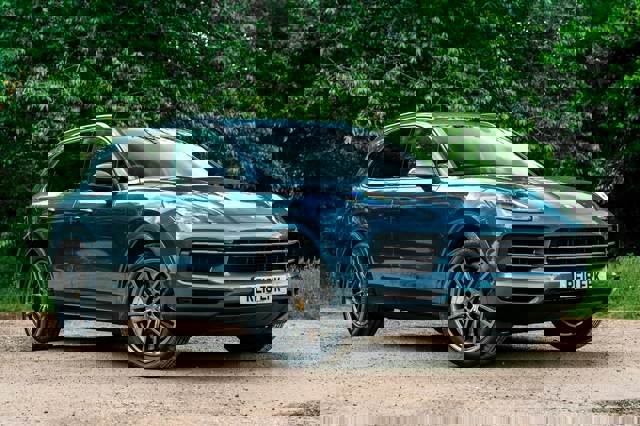
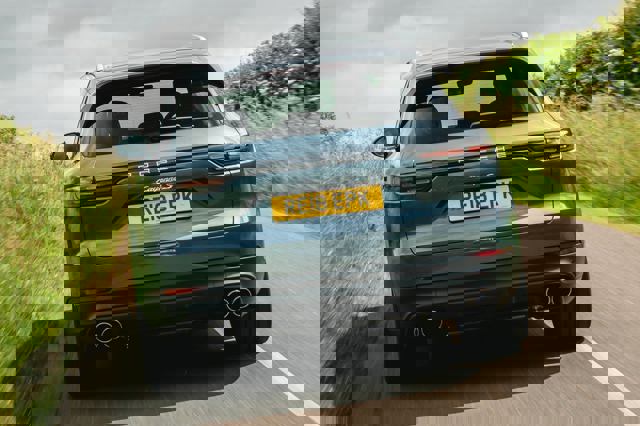
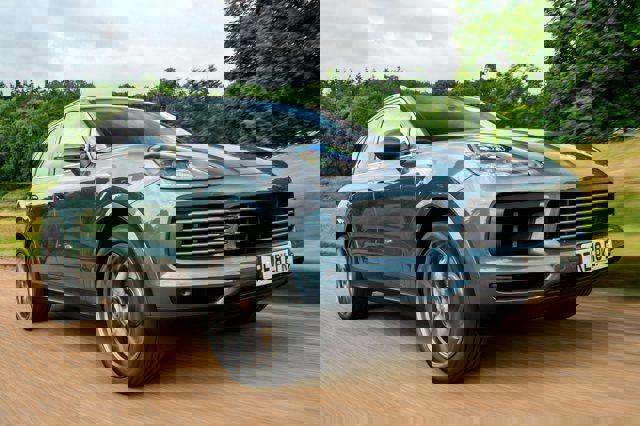
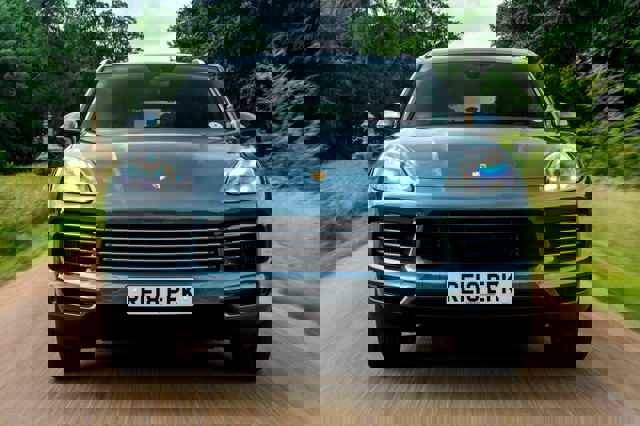
We wouldn’t call it beautiful, but the Porsche Cayenne is more elegant and less aggressive than previous models. It will turn heads, especially if you’re making the most of its sporting credentials on a track day.
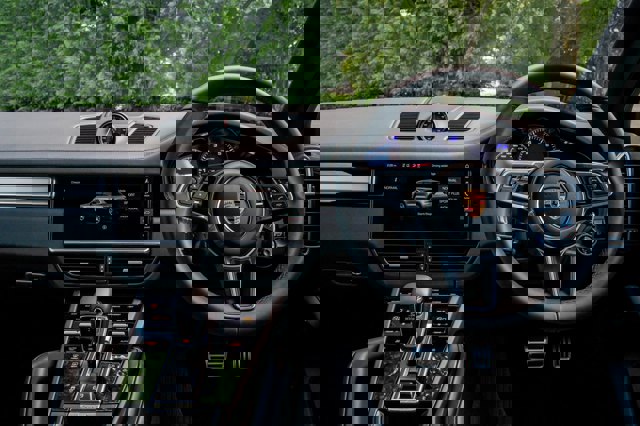
The jury might be out on the exterior styling, but the interior needs no debate. The luxury-grade quality is matched by a design that fuses the best elements of the Porsche 911 and Panamera. There are too many buttons, but the widescreen infotainment system is a class act.
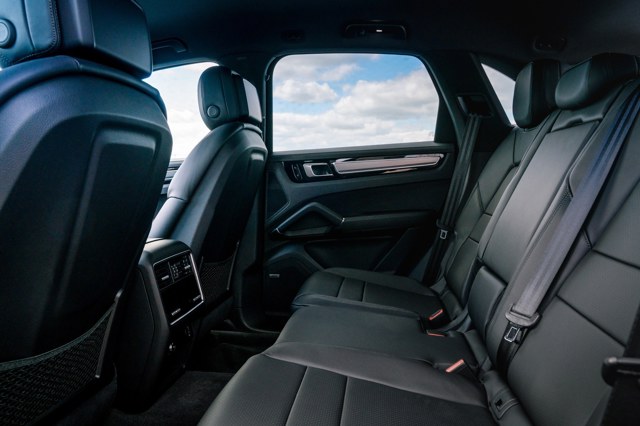
You get the familiar commanding view of the road ahead, but the driving position is more low-slung than rival SUVs, giving you the feel that you’re driving a sports car. Look over your shoulder and you’ll discover that you’re not, because there’s enough room in the back for three adults, while the boot is large enough to shame some estate cars.
Not that many estate cars drive as sweetly as a Porsche Cayenne. It’s the ultimate driver’s SUV, offering supreme comfort when you need it, but the precision and sharpness of a sports car when the mood takes you. It’s a big car, but it seems to shrink on a B-road.
The engines are another highlight. The entry-level V6 models are fast enough to entertain, but the V8 engines are the star of the show. Fuel economy isn’t a strong point, which is why Porsche offers a pair of E-Hybrid models. One uses a V6 engine, the other a V8, but both offer enough electric range to complete a short commute. The running costs are almost manageable, but you’ll still require deep pockets.
Which is arguably the Cayenne’s biggest problem. It’s an expensive car to buy and run, especially once you take into account the servicing and insurance. At least the car has been on sale long enough for examples to be available via the Porsche approved used scheme. The purchase price will be cheaper, but the running costs will be the same.
Reviews for Porsche Cayenne's top 3 rivals
.jpg?width=240&height=160&rmode=crop)

.jpg?width=240&height=160&rmode=crop)

.jpg?width=240&height=160&rmode=crop)
Porsche Cayenne handling and engines
- Engines range from Cayenne GTS to Cayenne Turbo
Porsche Cayenne 2026: Handling and ride quality
It’s amazing how agile and lithe a large and heavy SUV can be. You will enjoy driving the Porsche Cayenne. Heck, you can even take it on a track day.
The steering is a particular highlight, with a sharp and tight setup. It’s enhanced by a well-positioned steering wheel, which combines with a low-slung driving position to create a feel that’s more akin to a Porsche 911.
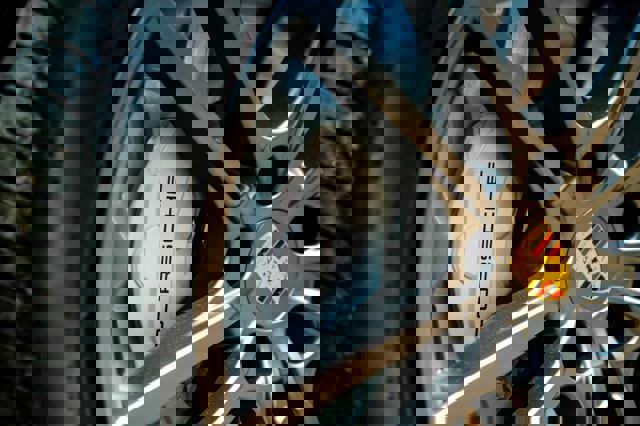
Cayenne S models get adaptive dampers, while the adaptive air suspension enhances the sportiness and luxury car ride. Predictably, there are many options available, including costly ceramic brakes and electric rear axle steering. As for the ride quality, stick with the 19-inch alloys for the best result, but the ride doesn’t suffer too much on 21-inch rims.
Porsche Cayenne 2026: Engines
The standard Cayenne is powered by a 3.0-litre V6 engine producing 340PS and 450Nm of torque. This is enough for it to complete the zero to 62mph sprint in just 6.2 seconds, before going on to hit a top speed of 152mph.
Strangely, the Cayenne S is powered by a 2.9-litre V6 engine, but this time it’s producing 440PS and 550Nm of torque. The 0-62mph time drops to 5.2 seconds, while the top speed increases to 164mph. The Cayenne GTS gets a thunderous and sonorous 4.0-litre V8 producing 460PS and 620Nm. At 4.8 seconds, it’s slightly slower to 62mph, but top speed increases to 168mph.
The Cayenne Turbo is more sophisticated, with its V8 producing 550PS and 770Nm of torque. It’ll hit 62mph in 4.1 seconds, going on to top 178mph.
The Cayenne E-Hybrid combines a 3.0-litre V6 petrol engine with a 136PS electric motor, while the Cayenne Turbo S E-Hybrid uses the same electric motor, but pairs it with a V8 petrol engine.
Porsche Cayenne 2026: Safety
The Porsche Cayenne was awarded a five-star safety rating when it was crash-tested by Euro NCAP in 2017. There’s a full suite of airbags, along with an active pop-up bonnet for pedestrian safety. Autonomous emergency braking is also standard, but lane-keep assist is an option.
Other options include adaptive cruise control, night vision display, lane-change camera, traffic sign recognition and a 360-degree parking camera.
Porsche Cayenne 2026: Towing
The Porsche Cayenne has a maximum towing capacity of 3500kg, so it’s ideal for towing caravans, horseboxes and large trailers. It’s worth noting that the plug-in hybrid models offer the best towing capacity of any alternative-fuel car.
| Engine | MPG | 0-62 | CO2 |
|---|---|---|---|
| Cayenne GTS | - | - | 319 g/km |
| Cayenne Turbo | - | 3.3 s | 319 g/km |
| Cayenne Turbo E-Hybrid | - | - | 90 g/km |
Porsche Cayenne interior

- Boot space is 549–1464 litres
| Dimensions | |
|---|---|
| Length | 4942 mm |
| Width | 2194 mm |
| Height | 1636 mm |
| Wheelbase | 2895 mm |
Porsche Cayenne 2026: Practicality
The Porsche Cayenne is a big car, extending to over 4.9 metres in length, with the E-Hybrid weighing over 2.3 tonnes. It won’t surprise you to discover that this results in a massive boot, with the Cayenne boasting 770 litres of luggage capacity.
This increases to 1710 litres if you fold the rear seats, which gives the Cayenne estate car qualities. Make no mistake, this is a practical car, even if the E-Hybrid loses 100 litres, thanks to the battery pack in the boot.
There’s also loads of cabin space, with ample room for five adults to sit in comfort. We’d argue that the middle rear seat is the least comfortable of the five, but that’s only because Porsche spent so much time sculpting the other four seats to within a millimetre of perfection. It feels massive in the front, with the driver and passengers given a commanding view of the road ahead.
Porsche Cayenne 2026: Quality and finish
We’d struggle to criticise the quality and finish of the Porsche Cayenne. Yes, it’s an expensive car, but the cabin shows where the money has been spent. It’s a flawless interior, with most of the cabin lined in leather. Elsewhere, you’ll find the softest of plastics and the richest materials, while the switchgear functions with precision and solidity.
But it’s the design that will leave the longest impression. Our only complaint would be the button count, which takes a while to get used to.
Porsche Cayenne 2026: Infotainment
All versions of the Cayenne get an impressive 12.3-inch touchscreen infotainment system. It certainly looks the part, with its glossy finish, but it’s not quite as intuitive as systems from rivals such as BMW and Mercedes-Benz. Apple CarPlay is fitted as standard, but it’s not compatible with Android Auto.
Functions that aren’t controlled via the touchscreen are operated using a glass touch surface, which feels upmarket and classy. A 4G modem, wi-fi hotspot and Porsche Connect services come as standard, along with dual seven-inch information screens ahead of the driver.
Porsche Cayenne value for money

Porsche Cayenne 2026: Prices
The entry-level Porsche Cayenne costs £57,195. That said, it’s hardly what you’d class as entry-level, not when you take into account the standard specification and the fact that it will hit 62mph in just 6.2 seconds.
Next up is the Cayenne S, which costs £69,818, while the Cayenne E-Hybrid costs around the same, at £69,980. The Cayenne GTS is the only other model to slot in below the £100,000 mark, with a price of £85,930.
The Cayenne Turbo costs £104,490, while the Cayenne Turbo S E-Hybrid is knocking on the door of £125,000. It’s also worth noting that Cayenne Coupe prices range from £62,129 to £125,946, so you’ll pay a premium for having less space.
All Cayenne models are available with a wide range of finance options, including PCP, leasing, hire purchase and contract hire.
Used prices start from £35,000, but these tend to be entry-level cars that are just out of warranty. Cayenne Turbo models cost considerably more, so you’ll need to spend the best part of £75,000 to secure one of these desirable cars.
Prices go up to £145,000, which highlights the fact that very few Cayenne models leave the showroom without a suite of options and accessories. The list price is only half the story – be prepared to dig deep to secure the desirable and must-have options.
Porsche Cayenne 2026: Reliability and running costs
We suspect running costs will be low on your list of priorities when buying a Porsche Cayenne. Even the ‘basic’ Cayenne can only muster 22.2mpg to 24.1mpg on a combined cycle, which seems at odds with the current push for fuel efficiency and low emissions.
The Cayenne S is even worse, at 21.9mpg to 23.9mpg, while the GTS drops to 20.0mpg to 21.2mpg. This is only slightly better than the Turbo, which has the potential to achieve 20.0mpg to 20.9mpg.
If fuel economy is a concern, it’s worth considering one of the plug-in hybrid models. The E-Hybrid offers a claimed 76.3mpg to 91.1mpg, while the Turbo S E-Hybrid could achieve 52.3mpg to 58.9mpg
Crucially, the Turbo S E-Hybrid offers a claimed 19 miles of driving electric range, which could be enough for your morning commute or the trip to the railway station. Meanwhile, the E-Hybrid could run for 30 miles on electric power.
Car insurance will be expensive, with even the entry-level Cayenne slotting into group 44. Some models are in group 50. Vehicle Excise Duty (VED) is similarly expensive thanks to the premium surcharge for cars costing more than £40,000. At least there’s a first-year discount for the plug-in hybrid models.
Satisfaction Index
 What is your car like to live with?
We need your help with our latest Satisfaction Index, so that we can help others make a smarter car buying decision. What's it like to live with your car? Love it? Loath it? We want to know. Let us know about your car - it will only take a few minutes and you could be helping thousands of others.
Help us with the Honest John Satisfaction Index nowPorsche Cayenne models and specs
This is an expensive car, but when you consider the performance, dynamic qualities and overall quality, it’s easier to justify the cost. The list prices are only part of the story – you’d do well to leave a Porsche showroom without spending at least £3,000 (potentially much more) on optional extras.
If the idea of a gas-guzzling SUV seems at odds with your view on eco matters, the E-Hybrid versions are worth a look. Indeed, they’re arguably the easiest Cayenne models to justify. Enough electric range for your daily commute, reasonable running costs and a semblance of eco-consciousness. Opt for the Turbo S E-Hybrid and you get the best of both worlds.
| Dimensions | |
|---|---|
| Length | 4942 mm |
| Width | 2194 mm |
| Height | 1636 mm |
| Wheelbase | 2895 mm |
| Miscellaneous | |
|---|---|
| Kerb Weight | 2220 kg |
| Boot Space | 549–1464 L |
| Warranty | 3 years / Unlimited miles |
| Servicing | 20000 miles |
| Costs | |
|---|---|
| List Price | - |
| Insurance Groups | 50 |
| Road Tax Bands | A–M |
| Official MPG | - |
| Euro NCAP Safety Ratings | |
|---|---|
| Adult | - |
| Child | - |
| Pedestrian | - |
| Overall | - |
| SUV | |||
|---|---|---|---|
| Version | List Price | MPG | 0-62 |
| GTS Bi Turbo 460 V8 Tiptronic S Auto Start/Stop 5dr | - | - | - |
| TURB0 4.0 V8 E-Hybrid Tiptronic S 5dr | - | - | - |
| Turbo GT Bi Turbo 640 V8 Tiptronic S Auto Start/Stop 5dr | - | - | 3.3 s |
Model History
August 2017
Porsche unveils Cayenne
This latest edition of the successful all-wheel drive four door sports car from the Stuttgart marque is a completely new development, and combines typical Porsche performance with everyday versatility.
At launch, there are two newly-developed six-cylinder petrol engines to choose from. The Cayenne is powered by a 340PS, three-litre V6 engine with a single turbocharger delivering 40PS more than the prior model. The 2.9-litre V6 twin-turbo engine in the Cayenne S develops 440PS – an increase of 20PS. Equipped with the optional Sport Chrono Package, the new Cayenne S accelerates from zero to 62 mph in less than five seconds.
The luggage compartment volume is now 770 litres – an increase of 100 litres. The wheels are one inch larger in diameter, with wider wheels and tyres on the rear axle for the first time, emphasising the enhanced driving dynamics. The distinctive, three-dimensional Porsche logo spans the redesigned rear lights, which feature a three-dimensional design and narrow LED strips.
The expanded performance range of the Cayenne, broadening both sportiness and comfort, is due in no small part to the new eight-speed Tiptronic S automatic gearbox. Shorter response times and sportier ratios in the lower gears enhance both on-road performance and off-road capability. At the other end of the expanded spread between comfort and sportiness, the taller eighth gear ensures lower revs, optimised fuel consumption and relaxed cruising.
August 2019
Cayenne Turbo S E-Hybrid announced
Porsche's flagship Cayenne now combines a 4.0-litre twin-turbo V8 petrol engine with an electric motor to produce a combined 680PS.
Paired with an eight-speed Tiptronic S automatic transmission, the Turbo S E-Hybrid produces 900Nm of torque and covers 0-62mph in 3.8 seconds. It can reach a top speed of 183mph.
Porsche says the Cayenne Turbo S E-Hybrid can drive under electric power for 19 miles, while WLTP fuel economy is between 52.3 and 58.9mpg. CO2 emissions are 85-90g/km.
In addition to the top model, the Cayenne E-Hybrid has been updated with a new petrol particulate filter and is now available to order.
Prices start from £68,358 for the Cayenne E-Hybrid while the Cayenne Turbo S E-Hybrid is priced from £123,349.
