
Volkswagen Beetle (2012 – 2019) Review
.jpg?width=640&height=426&rmode=crop)
.jpg?width=640&height=426&rmode=crop)
.jpg?width=640&height=426&rmode=crop)
.jpg?width=640&height=426&rmode=crop)
.jpg?width=640&height=426&rmode=crop)
.jpg?width=640&height=426&rmode=crop)
.jpg?width=640&height=426&rmode=crop)

Volkswagen Beetle (2012 – 2019) Verdict

 Huge improvement on previous Beetle. Distinctive interior harks back to original Beetle. Enjoyable to drive. Engine line-up includes 1.2 TSI 105PS and economical 1.6 TDI.
 Rear visibility isn't great.
Find out more about the Volkswagen Beetle (2012 – 2019)
Icon is a word that's banded around too frequently when it comes to car designs but the Beetle can rightly claim to be a true automotive icon. First seen in 1938 the original air-cooled Beetle was the 'people's car', an affordable and reliable motor that promises mass mobility for all. The intervening years saw more than 21.5 million Beetles sold worldwide until the final one was produced in Mexico in 2003.
Replacing an icon is never easy though. Volkswagen brought back the Beetle in 1998 with the 'new Beetle' but while it sold more than a million, it never caught the public's imagination in the same way, although it does have the distinction of being the first 'retro' model, coming several years before the MINI and Fiat 500.
Now Volkswagen is back with its new Beetle and a look that's much more in line with the original Beetle of the 1930s. It's certainly more masculine than the previous Beetle and far less twee - there's no vase on the dashboard for starters - while the interior harks back to the old model too with a flat dashboard and the recognisable flip-up glovebox built into it. Practicality is much improved with a boot that's almost 50 per cent bigger and more interior room too.
Overall quality and refinement is a huge step forward from the previous model and on the road it's far more together with sharper handling, a hugely improved ride and better steering. While the exterior shape is similar, underneath this Beetle is very different from its predecessor of 1998. It gets a good range of engines including Volkswagen's excellent TSI engines - a 1.2-litre, 1.4-litre and the top 2.0-litre with 200PS - plus there's an impressively frugal diesel in the shape of a 1.6 TDI BlueMotion Technology than averages a claimed 65.7mpg.
The new Beetle is well priced with on the road prices starting at a very competitive £14,875 - about the same as a MINI Cooper. It's an incredibly likeable car with plenty of charm and character, much more so than the previous 'new' Beetle. There's also an even more desirable Cabriolet version which was launched in April 2013.
Reviews for Volkswagen Beetle (2012 – 2019)'s top 3 rivals
.jpg?width=240&height=160&rmode=crop)

.jpg?width=240&height=160&rmode=crop)
.jpg?width=240&height=160&rmode=crop)
Volkswagen Beetle (2012 – 2019) handling and engines
- Engines range from 1.2 TSI to 2.0 TSI 220 DSG
- Readers report Real MPG to be between 30–64 mpg
The outside of the Beetle may be very different but the engine line up includes the usual Volkswagen suspects. From launch in early 2012 there will be two engines - a 1.2-litre TSI with 105PS that's fitted with a seven-speed DSG automatic gearbox along with a 1.4 TSI with 160PS and a standard manual gearbox.
Later in 2012 the 1.2 TSI will become available with a manual gaerbox while the top 2.0 TSI will also be introduced. At the same time the all important diesel version will launched in the shape of a 1.6 TDI BlueMotion Technology that averages a claimed 65.7mpg and emits 114g/km of CO2 meaning cheap annual tax rates and low BIK company car tax rates. It comes with a standard six-speed manual plus there's the option of a DSG version.
There's no performance version as such but the 2.0 TSI is shared with the Golf GTI and provides more than enough poke with 200PS in reserve. It sounds good too thanks to a modified exhaust which gives it a nice deep resonance on start up and when you accelerate. It certainly doesn't hang about with a 0-62mph time of 7.5 seconds when fitted with the six-speed DSG gearbox. It's surprisingly economical too given its power and averages a claimed 36.7mpg.
On the move it pulls very strongly in gear and if you choose the optional DSG gearbox, you'll find it responds well when you ask it to accelerate with quick kickdown and subsequent rapid upshifts. The only surprise is that Volkswagen hasn't yet confirmed whether this version will come with steering wheel mounted paddle shifts as standard. It seems odd to have them as an option on what is the raciest version.
The 2.0 TSI does get a lightweight strut-type suspension set-up at the front along with semi-independent rear suspension and also has the XDS electronic differential system from the Golf GTI. This also features on the 1.4 TSI and acts like a differential by bracking the inside wheel in a corner meaning you don't have to turn the steering wheel as much. It works very well making cornering more precise and accurate and although the Beetle could do with more feel through the steering, it's still fun and enjoyable to drive.
The ride is quite firm, but better that than too soft and wallowy. It's part of Volkswagen's measures to make the newest Beetle better to drive, especially in corners, helped by a longer wheelbase and wider track than the previous Beetle. It's still comfortable though and deals well with rough road surfaces. Along with the standard suspension, there is sports suspension available as an option which is stiffer and 15mm lower. The top model also gets a rear spoiler (as you can see in the picture above) but that won't be on all models and it does look sleeker without it.
Refinement is very impressive and the Beetle feels well put together, quiet and relaxed on the move. There's a little wind noise around the top of the windscreen pillars at motorway speeds but it's not intrusive.
| Engine | MPG | 0-62 | CO2 |
|---|---|---|---|
| 1.2 TSI | 51–52 mpg | 10.9–11.3 s | 127–128 g/km |
| 1.2 TSI DSG | 48–54 mpg | 10.9–11.3 s | 123–137 g/km |
| 1.4 TSI 150 | 49–50 mpg | 8.7 s | 132–134 g/km |
| 1.4 TSI 160 | 43 mpg | 8.3 s | 153 g/km |
| 1.6 TDI | 66 mpg | 11.5 s | 113 g/km |
| 1.6 TDI DSG | 66 mpg | 11.5 s | 114 g/km |
| 2.0 TDI 110 | 66 mpg | 11.0–11.5 s | 112 g/km |
| 2.0 TDI 110 DSG | 61 mpg | 11.0 s | 116 g/km |
| 2.0 TDI 140 | 58 mpg | 9.4 s | 129 g/km |
| 2.0 TDI 140 DSG | 52 mpg | 9.4 s | 140 g/km |
| 2.0 TDI 150 | 61–63 mpg | 8.9–9.2 s | 117–119 g/km |
| 2.0 TDI 150 DSG | 59 mpg | 8.9–9.2 s | 124–127 g/km |
| 2.0 TSI 210 | 39 mpg | 7.3–7.5 s | 169 g/km |
| 2.0 TSI 210 DSG | 37 mpg | 7.5 s | 176 g/km |
| 2.0 TSI 220 | 44 mpg | - | 150 g/km |
| 2.0 TSI 220 DSG | 42 mpg | - | 157 g/km |
Real MPG average for the Volkswagen Beetle (2012 – 2019)

Real MPG was created following thousands of readers telling us that their cars could not match the official figures.
Real MPG gives real world data from drivers like you to show how much fuel a vehicle really uses.
Average performance
85%
Real MPG
30–64 mpg
MPGs submitted
53
Volkswagen Beetle (2012 – 2019) interior
- Boot space is 310–905 litres
- Euro NCAP rating of five stars
| Dimensions | |
|---|---|
| Length | 4278–4288 mm |
| Width | 1808–2021 mm |
| Height | 1486–1502 mm |
| Wheelbase | 2537–2538 mm |
It’s good to see that Volkswagen has given the Beetle a bespoke interior so it’s far more than just a Golf in a posh frock. As with the outside, the unique design harks back to the original Beetle with a vertical dash that comes in the same colour as the outside – a nice touch that works really well on the brighter colours, or it comes in a carbon fibre effect trim. There’s a split level glovebox with a conventional lower bit while the top section is integrated into the dash with an upward folding lid, an instantly recognisable bit of design from the classic air cooled Beetle.
Compared to the original new Beetle, this second generation has a far more special feel to it inside. The quality of the materials is good, although some of the plastics lower down are borderline scratchy, but refinement is impressive and the layout neat and distinctive. Oh – and the little glass vase of the old model has been ditched too as the Beetle aims to ‘man up’.
The emphasis seems to be on keeping things simple and uncluttered. So the main instrument cluster has just three dials – dominated by the speedo like the classic Beetle, plus a rev counter and a (strangely large) fuel gauge. As an option you can have extra dials (stuff like turbo boost pressure) on the top. The steering wheel is unique to the Beetle too and looks good, although we’d question why it needs a flat bottom – a feature that’s usually the preserve of performance models.
There’s a far more vertical windscreen than the original new Beetle, so from behind the wheel it has a similar feel to a MINI. The driving position is pretty much spot on – not too high that you’re perched on top of it but high enough to give you decent all round visibility. It feels very spacious in the front too, helped by the fact the seats slide a long way back (although this means zero rear legroom) while the fact this Beetle is wider than the last one definitely has benefits for elbow room.
It’s a three-door only but getting to the back seats isn’t too much of a strain (you’re not likely to stick the grandparents there but for kids it’s a doddle) as the front seats fold and slide while the doors open wide. There’s decent room in the back and a surprising amount of headroom, although legroom is a little tight if you’ve got a reasonably tall adult in the front. It’s also worth noting that there are only two seats in the back.
The good news is that the boot is far more useable than the previous Beetle. It’s now 310 litres (compared to just 209 litres in the old one) meaning it’s about the same as a Skoda Fabia. Plus the tailgate has a usefully wide opening so it no longer feels like a design that’s been lead by style rather practicality. You can fold down the back seats too which increase the boot area to 905 litres.
There will be three trim levels - Beetle, Design and Sport - although details of what the actual equipment for each will be has yet to be finalised. However, all models will come with air conditioning, DAB radio, alloy wheels, a multi-function leather steering wheel, Bluetooth, colour co-ordinated dash and door panels on Design while Sport will have climate control, Piano Black dash panels, parking sesnors and black wing mirrors.
Volkswagen Beetle (2012 – 2019) models and specs
| Dimensions | |
|---|---|
| Length | 4278–4288 mm |
| Width | 1808–2021 mm |
| Height | 1486–1502 mm |
| Wheelbase | 2537–2538 mm |
| Miscellaneous | |
|---|---|
| Kerb Weight | 1297–1504 kg |
| Boot Space | 310–905 L |
| Warranty | 3 years / 60000 miles |
| Servicing | 18000 miles |
| Spare Wheel | |||
|---|---|---|---|
| Standard | Space-saving spare wheel | ||
| Costs | |
|---|---|
| List Price | £16,490–£26,610 |
| Insurance Groups | 10–26 |
| Road Tax Bands | C–I |
| Official MPG | 37.2–65.7 mpg |
| Euro NCAP Safety Ratings | |
|---|---|
| Adult | - |
| Child | - |
| Pedestrian | - |
| Overall | 5 |
On sale until July 2019
| Hatchback | |||
|---|---|---|---|
| Version | List Price | MPG | 0-62 |
| 1.2 TSI 105 3dr | £17,750 | 52.3 mpg | 10.9 s |
| 1.2 TSI 105 Design 3dr | £20,145 | 52.3 mpg | 10.9 s |
| 1.2 TSI 105 Design DSG7 3dr | £21,605 | 54.3 mpg | 10.9 s |
| 1.2 TSI 105 Dune 3dr | £22,210 | 51.4 mpg | 11.3 s |
| 1.2 TSI 105 Dune DSG7 3dr | £23,670 | 54.3 mpg | 11.3 s |
| 1.4 TSI 150 Design 3dr | £22,090 | 49.6 mpg | 8.7 s |
| 2.0 TDI 110 Design DSG7 3dr | £23,700 | 61.4 mpg | 11.0 s |
| 2.0 TDI 150 Dune 3dr | £25,005 | 62.8 mpg | 9.2 s |
| 2.0 TDI 150 Dune DSG 3dr | £26,610 | 58.9 mpg | 9.2 s |
| 2.0 TDI 150 R Line 3dr | £24,760 | 61.4 mpg | 8.9 s |
| 2.0 TDI 150 R Line DSG 3dr | £26,365 | 58.9 mpg | 8.9 s |
| 2.0TDI 110 Design 5speed 3dr | £22,240 | 65.7 mpg | 11.0 s |
On sale until August 2018
| Hatchback | |||
|---|---|---|---|
| Version | List Price | MPG | 0-62 |
| 1.4 TSI 150 Design 3dr | £22,090 | 49.6 mpg | 8.7 s |
| 1.4 TSI 150 Sport BlueMotion Technology Start+Stop 3dr | £22,790 | 48.7 mpg | 8.7 s |
| 2.0 TDI 110 5speed BlueMotion Technology Start+Stop 3dr | £18,365 | 65.7 mpg | 11.5 s |
| 2.0 TDI 150 Design BlueMotion Technology Start+Stop 3dr | £21,440 | 61.4 mpg | 8.9 s |
| 2.0 TDI 150 Design DSG Start+Stop 3dr | £23,045 | 58.9 mpg | 8.9 s |
| 2.0 TDI 150 Sport BlueMotion Technology Start+Stop 3dr | £23,260 | 61.4 mpg | 8.9 s |
| 2.0 TDI 150 Sport DSG Start+Stop 3dr | £24,865 | 58.9 mpg | 8.9 s |
| 2.0 TSI 220 Sport BlueMotion Technology Start+Stop 3dr | £24,020 | 43.5 mpg | - |
| 2.0 TSI 220 Sport DSG Start+Stop 3dr | £25,540 | 42.2 mpg | - |
| 2.0 TSI Turbo Black BlueMotion Technology Start+Stop 3dr | £24,720 | 43.5 mpg | - |
| 2.0 TSI Turbo Black DSG Start+Stop 3dr | £26,240 | 42.2 mpg | - |
| 2.0 TSI Turbo Silver BlueMotion Technology Start+Stop 3dr | £24,720 | 43.5 mpg | - |
| 2.0 TSI Turbo Silver DSG Start+Stop 3dr | £26,240 | 42.2 mpg | - |
On sale until September 2014
| Hatchback | |||
|---|---|---|---|
| Version | List Price | MPG | 0-62 |
| 1.6 TDI 105 BMT 3dr | £17,660 | 65.7 mpg | 11.5 s |
| Design 1.4 TSI 160 3dr | £20,265 | 42.8 mpg | 8.3 s |
| Design 1.6 TDI 105 BMT 3dr | £20,035 | 65.7 mpg | 11.5 s |
| Design 1.6 TDI 105 BMT DSG 3dr Auto | £21,495 | 65.7 mpg | 11.5 s |
| Design 2.0 TDI 140 3dr | £20,735 | 57.6 mpg | 9.4 s |
| Design 2.0 TDI 140 DSG 3dr Auto | £22,340 | 52.3 mpg | 9.4 s |
| Sport 1.4 TSI 160 3dr | £22,085 | 42.8 mpg | 8.3 s |
| Sport 2.0 TDI 140 3dr | £22,555 | 57.6 mpg | 9.4 s |
| Sport 2.0 TDI 140 DSG 3dr Auto | £24,160 | 52.3 mpg | 9.4 s |
| Sport 2.0 TSI 210 3dr | £23,315 | 38.7 mpg | 7.5 s |
| Sport 2.0 TSI 210 DSG 3dr Auto | £24,830 | 37.2 mpg | 7.5 s |
| Turbo Black 2.0 TSI 210 3dr | £24,015 | 38.7 mpg | 7.3 s |
| Turbo Black 2.0 TSI 210 DSG 3dr Auto | £25,530 | 37.2 mpg | 7.5 s |
| Turbo Silver 2.0 TSI 210 3dr | £24,015 | 38.7 mpg | 7.3 s |
| Turbo Silver 2.0 TSI DSG 210 3dr Auto | £25,530 | 37.2 mpg | 7.5 s |
On sale until May 2014
| Hatchback | |||
|---|---|---|---|
| Version | List Price | MPG | 0-62 |
| GSR 2.0 TSI 3dr | £25,100 | 38.7 mpg | 7.3 s |
| GSR 2.0 TSI DSG 3dr Auto | £26,610 | 37.2 mpg | - |
On sale until April 2013
| Hatchback | |||
|---|---|---|---|
| Version | List Price | MPG | 0-62 |
| Fender 2.0 TDI 3dr | £23,015 | 57.6 mpg | 9.4 s |
| Fender 2.0 TDI DSG 3dr | £24,615 | 52.3 mpg | 9.4 s |
On sale until December 2012
| Hatchback | |||
|---|---|---|---|
| Version | List Price | MPG | 0-62 |
| 1.2 TSI DSG 3dr | £16,600 | 47.9 mpg | 10.9 s |
On sale until June 2012
| Hatchback | |||
|---|---|---|---|
| Version | List Price | MPG | 0-62 |
| Design 1.4 TSI 3dr | £19,605 | 42.8 mpg | 8.3 s |
On sale until March 2012
| Hatchback | |||
|---|---|---|---|
| Version | List Price | MPG | 0-62 |
| 1.2 TSI DSG 3dr Auto | £16,490 | 47.9 mpg | 10.9 s |
| Design 1.2 TSI DSG 3dr Auto | £18,895 | 47.9 mpg | 10.9 s |
| Sport 1.4 TSI 3dr | £21,220 | 42.8 mpg | 8.3 s |
Model History
- April 2011: Volkswagen revealed the new Beetle
- July 2012: Volkswagen expanded the Beetle range
- September 2012
- May 2013: Limited Edition 210PS Volkswagen Beetle GSR announced
April 2011
Volkswagen revealed the new Beetle
Went on sale in North America, then mainland Europe and finally the UK in early 2012. The latest generation moves away from design of the New Beetle of 1998 and instead draws on cues from the original and Beetle Ragster concept shown in Detroit in 2005. As such it’s longer, wider and lower, giving a more masculine and dynamic appearance.
The Beetle now measures 4,278 mm in length (+152 mm), 1,808 mm in width (+84 mm) and 1,486 in height (-12 mm). The track width front and rear, as well as the wheelbase at 2,537 mm, are also increased.
The car’s new proportions mean the roof extends back further, the windscreen is shifted back and the rear section is now more akin to that of the original Beetle. The boot capacity is a practical 310 litres, up from 209 litres in the 1998 model. The Beetle has four seats, with a split-fold rear seat for added versatility.
Inside the cabin, the Beetle’s designers created a modern, practical and distinctive appearance with easy to identify and ergonomic controls. Certain features, such as the glovebox and colour accent panels hark back to the original.
Three trim levels will be available – Beetle, Design and Sport – and each will be endowed with its own individual character and features. A wide range of innovative optional equipment will also be available, ranging from Keyless Access through satellite navigation systems and a panoramic sunroof to bi-xenon headlights and LED daytime running lights – all of which are available for the first time on a Beetle.
In the UK, a choice of four engines will be offered: three petrol – a 1.2-litre TSI 105 PS, a 1.4-litre TSI 160 PS and a 2.0-litre TSI 200 PS; and one diesel – a 1.6-litre 105 PS with BlueMotion Technology. Thanks to the addition of Stop/Start and battery regeneration systems the Beetle 1.6-litre 105 PS is estimated to have a combined fuel consumption of 65.7 mpg and carbon dioxide emissions of 112 g/km.
As well as being economical and environmentally sound, the Beetle is also built to be one of the safest cars on the road thanks not only to features such as standard ESP and six airbags but also a laser-welded and galvanised body structure which has one of the highest torsional rigidity values in the segment. In addition the range-topping engine, the 2.0-litre 200 PS, will feature standard XDS electronic differential lock as fitted to the Golf GTI.
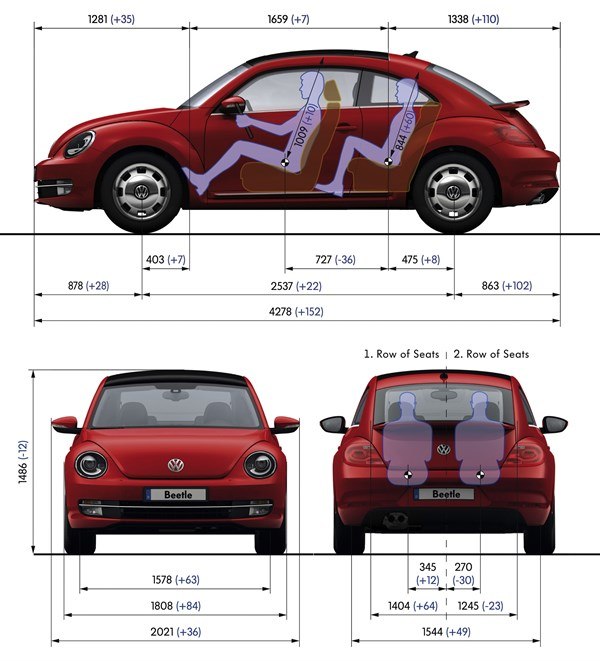
July 2012
Volkswagen expanded the Beetle range
Now with a 140PS 2.0-litre TDI and a 200PS 2.0-litre TSI as supply frees up. Both new Beetles are available with a choice of six-speed manual or six-speed DSG gearboxes.
Trim levels are Design or Sport trim for the 2.0 TDI and Sport or special-edition Turbo Black or Turbo Silver for the TSI, with 19-inch ‘Tornado' alloys.
Design trim includes 17-inch alloy wheels in a choice of two styles, Bluetooth telephone pre-prep, an RCD 510 DAB CD/radio with MDI multi-device interface (for connecting an iPod or similar), front fog lights, rear Isofix preparation, an alarm, manual air conditioning, multifunction leather-wrapped steering wheel and body-coloured door and dashboard panels.
The Sport specification adds 18-inch alloys in a choice of styles, tinted glass, cruise control, sports seats, parking sensors, gloss black door mirrors (silver or black on ‘Turbo' special editions), gloss black dashboard and door panel and 2Zone electronic climate control. Uniquely, the 2.0-litre TSI 200 PS Sport comes with highlights over and above other models. These include: four-link rear suspension, twin chromed exhaust pipes, red brake calipers and a body-coloured rear diffuser.
September 2012
Volkswagen added two more engine derivatives to the Beetle line-up, thus completing the range and not only lowering the entry-level price by over £1,400, but also reducing the entry-level carbon dioxide emissions value.
There's the 1.2-litre TSI 105 PS with a six-speed manual gearbox (joining the DSG version of the same powerplant) and the 1.6-litre TDI 105 PS with BlueMotion Technology which is offered with either a five-speed manual or seven-speed DSG transmission. Both entry level models are available in entry-level ‘Beetle’ or ‘Design’ trim.
The entry-level 1.2-litre TSI with manual gearbox is priced at £15,195 (RRP OTR), which is £1,405 less than the current starting point for the range (for the same 1.2-litre engine but with a DSG gearbox).
Likewise, entry-level carbon dioxide emissions are lowered by 12 per cent to 113 g/km thanks to the addition of the 1.6-litre TDI engine with BlueMotion Technology modifications. As well as bringing lower CO2 values and a combined mpg value of 65.7, the addition of this smaller engine lowers the threshold for diesel-powered Beetle ownership by over £3,000, with the 1.6-litre TDI costing £17,030 (RRP OTR).
| Trim level |
Engine derivative |
CO 2 , g/km |
Comb’d mpg | Price, £ RRP OTR |
| Beetle | 1.2-litre TSI 105 PS 6 spd manual | 137 | 47.9 | 15,195 |
| Beetle | 1.2-litre TSI 105 PS 7 spd DSG | 137 | 47.9 | 16,600 |
| Beetle | 1.6-litre TDI 105 PS BMT 5 spd manual | 113 | 65.7 | 17,030 |
| Design | 1.2-litre TSI 105 PS 6 spd manual | 137 | 47.9 | 17,570 |
| Design | 1.2-litre TSI 105 PS 7 spd DSG | 137 | 47.9 | 19,030 |
| Design | 1.4-litre TSI 160 PS 6 spd manual | 153 | 42.8 | 19,605 |
| Design* | 1.6-litre TDI 105 PS BMT 5 spd manual | 113 | 65.7 | 19,100 |
| Design* | 1.6-litre TDI 105 PS BMT 7 spd DSG | 114 | 65.7 | 20,560 |
| Design | 2.0-litre TDI 140 PS 6 spd manual | 129 | 57.6 | 20,085 |
| Design | 2.0-litre TDI 140 PS 6 spd DSG | 140 | 52.3 | 21,680 |
| Sport | 1.4-litre TSI 160 PS 6 spd manual | 153 | 42.8 | 21,370 |
| Sport | 2.0-litre TSI 200 PS 6 spd manual | 172 | 38.2 | 22,295 |
| Sport | 2.0-litre TSI 200 PS 6 spd DSG | 179 | 36.7 | 23,805 |
| Sport | 2.0-litre TDI 140 PS 6 spd manual | 129 | 57.6 | 21,850 |
| Sport | 2.0-litre TDI 140 PS 6 spd DSG | 140 | 52.3 | 23,445 |
| Turbo Black/ Silver | 2.0-litre TSI 200 PS 6 spd manual | 172 | 38.2 | 22,995 |
| Turbo Black/ Silver | 2.0-litre TSI 200 PS 6 spd DSG | 179 | 36.7 | 24,505 |
May 2013
Limited Edition 210PS Volkswagen Beetle GSR announced
Back in 1973, VW launched the Beetle GSR for the European market. Dubbed the ‘Yellow-Black Racer’, it was based on the Beetle 1303 S. ‘GSR’ stands for ‘Gelb-Schwarze Renner’ in German, which means ‘Gold-Black Racer’. Only 3,500 of the original 1973 model were produced as well.
For the first time, UK Volkswagen Beetle fans can order a new GSR model with a 210PS petrol turbo engine so it has 'go' to match the 'show'. Only 100 are destined for the UK.
The bonnet and the bootlid of the 1973 Beetle were painted in matt black, as were the bumpers, while black trim strips underneath the side windows and black/yellow side stripes above the door sills rounded off the look. Now, yellow and black are the link between old and new – the bonnet and the bootlid of the new Beetle GSR are black once again, and this time so are the roof and the exterior mirror trims. Black/yellow stripes with ‘GSR’ lettering ensure a unique silhouette above the side sills. Yellow painted bumpers in new R-Line design and a larger than standard yellow and black rear spoiler complete the GSR look. Unlike the older Beetle – and for those who prefer something a little more subtle – the new Beetle GSR can also be ordered in Platinum Grey and Black.
While the 1973 GSR came with 15-inch steel wheels with 175 size tyres, the latest model features 19-inch ‘Tornado’ alloy wheels with 235/40 tyres. The black/yellow interior of the GSR from days gone by featured a leather sports steering wheel and sports seats. Four decades later, customers demand more, and the GSR comes with R-Line racing seats (with fabric covers and contrasting yellow stitching), a high-grip leather sports steering wheel (also with contrasting yellow stitching) and a badge with the car’s special-edition number (1 to 3,500). The car also boasts an R-Line dash pad, GSR gear stick, leather handbrake lever gaiter and black floor mats with contrasting yellow embroidery.
Forty years ago, the yellow/black Beetle had just 50PS. But with its 2.0-litre turbocharged 210PS engine the GSR needs just 7.3 seconds to accelerate to 62 mph. It has a top speed of 142mph, 280Nm of torque from 1,700 rpm to 5,200 rpm, and is expected to return a combined fuel economy of 38.7 mpg with CO 2 emissions of 169 g/km. The new Beetle GSR can be ordered with either a six-speed manual or DSG gearbox. The manual Beetle GSR costs £24,900 (OTR RRP) with a £1,500 premium for DSG. The car is available to order now with first deliveries expected in September.
Beetle lovers who don’t manage to secure one of the UK’s 100 Beetle GSR models can still get their hands on a faster Beetle: all 2.0-litre TSI models factory ordered from 1-5-2013 come with the upgraded engine, offering 210PS, rather than the previous model’s 200PS.
What to watch out for
EA888 1.8TFSI and 2.0TFSI engines recalled in USA because the rear camshaft lobe is prone to unexpectedly shear off from the shaft. The failure causes reduced engine power and loss of vacuum pump power, cutting vacuum supply to the brake booster and eventually resulting in increased braking effort."A reduction in engine power and/or increased need for braking effort after vacuum reserve has been depleted while driving can increase the risk of a crash," a statement cautions. The campaign affects approximately 92,000 vehicles including the 2015-2016 Beetle, Beetle Convertible, Golf, Golf GTI, Golf SportWagen, Jetta and Passat. In notifying the National Highway Traffic Safety Administration, VAG stated that the root cause of the camshaft failures has not been fully understood. The company is still continuing an in-depth failure analysis and development of a repair solution, however a fix may not be ready until the end of the first quarter next year.
26-11-2015:Volkswagen announced fix for EA189 1.6TDI and 2.0TDI engines. A “flow transformer” will be fitted directly in front of the air mass sensor on the EA189 1.6TDI engine. This is a mesh that calms the swirled airflow in front of the air mass sensor and will improve the measuring accuracy of the air mass sensor. (The air mass sensor determines the air mass throughput, which is a very important parameter for the engine management for an optimum combustion process.)In addition, a software update will be performed on the 1.6TDI. The workshop time is expected to be less than a hour. The EA189 2.0TDI engines will get a software update. The programming time for this will be around half an hour. The objective is still to achieve the applicable emission targets without any adverse effects on the engine output, fuel economy and performance. However, as all model variants first have to be measured, the achievement of these targets cannot yet be finally confirmed. Based on this, service concepts are currently being developed for all 28 EU markets concerned. The aim is to implement the update in the first vehicles during a recall starting in January 2016. However, to compete the entire recall is likely to take until the end of 2016. Volkswagen will contact all customers and endeavour to consider individual customer needs during the implementation of the recall to avoid any disadvantages for the customer such as possible loss of mobility. All customers will be offered free courtesy cars if required. Since the beginning of October 2015, all Volkswagen customers have been able to check for themselves whether their vehicle is affected by the diesel issue. At www.volkswagen.de/info every customer can enter their vehicle identification number to obtain clear information.
19-02-2016:Complaint of VW Beetle dual zone climate control working insonsistently. "Even if we have it synced to have both sides at the same temp it will blow hotter from some vents than others. It's pretty sporadic at times, some times its one side of the car is a lot hotter others it's just one vent. It doesn't seem to matter if it is set on auto or manual. Local independent vw garage can't find any associated fault codes but when we go into the heating ecu you can watch the temps rise from random vents."
11-09-2016:Loud noise reporterd from manual transmission of 2012 VW Beetle 1.4TSI. Seems to go when clutch in; sometimes it stops doing it if put in a gear and taken it back out. Also when changing gears sometimes feels like it is juddering. Probably bearings or a bad gearboix case.
24-11-2016:Complaint that routine CP24 technical update alters the way the lighting system interacts. Before the update the speedometer dials illuminated when the ignition was switched on. After update they only illuminate if headlights are switched on. They do not come on when sidelights are selected (which are illegal to drive on anyway). However, foglights can now be switched on when the side lights switch is selected and that then illuminates the dials. Owner feels lack of illumination of the dials is dangerous because speeds are graduated in 20mph increments and it's diffcult to see if you are doing 30. VW dealer told him original system cannot be restored.
08-04-2019:Report of turbo actuator failing on 2015 VW Beetle at 10,950 miles (didn't say if petrol of diesel). Replaced FoC out of goodwill.
24-11-2021:Report of throttle body failure on 2018 Beetle. Car has covered 9496 miles and full service history. Owner charged £800 with neither dealer or VW UK willing to contribute towards the cost of repair.
