

Many learners will opt to buy a car before they pass their test - that way they can get practice in before taking the practical test, and they'll also be ready to get out on the road right away once they pass.
Obviously a learner will have to display L plates whenever they're at the wheel, and the red L on a white squre is instantly recognisable. But what symbols to learners display elsewhere in the world? See below for a selection of L plates from around the planet.
United Kingdom
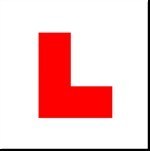
In the UK, provisional licence holders must display an L plate when driving on the road, the L plate has to be of the correct dimensions and shouldn’t be chopped down to a certain size or shape to fit. It’s also a requirement that the L plate is placed prominently on the outside of the car, rather than in the windows.
Wales

The same rules apply to Welsh learner plates as to English, however they can display a red letter D instead of an L because the Welsh word for learner is dysgwr. It’s worth noting that outside of Wales the D plate isn’t recognised and an L plate must be displayed.
Northern Ireland

In Northern Ireland drivers who have just passed their test have to display an R plate, which stands for restricted, for one year. Drivers with R plates are restricted to 45mph, even on motorways, whenever driving in Northern Ireland. If they cross the border or travel to England they no longer need display R plates.
Australia/ New Zealand

In Australia and New Zealand the L plate is orange or yellow with a black L. It’s possible to start learning at 15 years and 9 months old in Australia with a learner licence, which then entitles drivers to take a driving course and a test. After that a provisional licence is awarded and P plates must be displayed for three years. After that it can be upgraded to a full ‘open’ licence.
Canada

The way vehicle and driver licensing is regulated varies by province in Canada. In British Columbia a learner must display a red L plate for at least 12 months, after which they can take a test and graduate to the N, or new driver stage. This lasts two years, and then a final test grants a full licence.
Hong Kong

The rules for learning to drive in Hong Kong are similar to the rules in the UK. Drivers apply for a learner licence and then undergo training before taking a test. Learner licence holders must display an L plate similar to the UK one, as pictured, although with a symbol complimenting the L. The symbol means ‘to learn’ in traditional Chinese.
Italy

Italian driving school cars display the words Scuola Guida on a white reflective plate, but learners can also operated privately owned vehicles for practice. Private cars must display a P plate when learners are at the wheel.
Spain

Spanish learners display a blue plate with a white L and the word ‘Practicas’ when they’re taking lessons. After they pass they have to display a new driver plate, which is green with a white L.
Japan

In Japan there are a selection of different stickers identifying particular levels of driver. Learners must display the sign pictured above when undertaking lessons or practicing. Once the learner has passed their test they must display the ‘Wakaba’ mark pictured below.
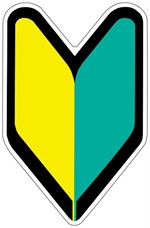
This is the Japanese equivalent of a P plate, denoting that the driver has recently passed. In the UK, P plates are optional, but the Japanese 'Wakaba' mark must be displayed by law for one year after the driver passes.

This badge is something like the opposite of an L plate, in that it signifies an older driver rather than a new driver. All drivers over 75 must display the symbol in Japan and it is recommended for drivers over 70. Both this and the Wakaba mark above are designed to warn other road users that the drivers of cars displaying them are likely to be less able.

Malaysians can learn to drive at 17. Before getting a learner licence they must pass a test on the highway code and undergo a six hour theory lesson. After that they receive a learners probationarly licence. It lasts three months and in that time drivers must display the blue plate pictured. After around ten hours of lessons, drivers should be capable of passing their practical test.
L plates are not a requirement in many countries - particularly those with more lax driving regulations. For example, progressing from a learner licence to a full licence in India requires drivers to do a very simple driving test - it takes no longer than ten minutes - and to be "conversant about vehicle systems, driving, traffic rules and regulations."



